


Water protection is an important part of product quality, especially for electrical and electronic equipment used outdoors, in workshops, and in places where splashing water is part of everyday operation. A housing may look well sealed from the outside, but water can still find its way through joints, cable entries, control buttons, connectors, and other small openings. Once water reaches sensitive internal components, it may cause corrosion, unstable operation, electrical faults, or premature product failure.
At Guangzhou Chuangge Automation Equipment Co., Ltd., we specialize in customized testing equipment for manufacturers, laboratories, and quality inspection teams. Our IPX3/IPX4 Oscillating Tube Rain Test Apparatus is designed to help users evaluate the water ingress protection of enclosures and products under specified spray conditions. By moving a perforated tube through a controlled range of angles, the apparatus distributes water toward the test sample and helps reproduce the exposure conditions required by the selected test procedure.
We understand that buyers are not simply looking for a machine that sprays water. They need equipment that matches the applicable standard, accommodates their products, fits their testing workflow, and can be operated and maintained without unnecessary complications. That is why we begin with the application and test requirements before confirming a customized configuration.
The IPX3/IPX4 Oscillating Tube Rain Test apparatus is commonly considered for electrical enclosures, household appliances, electronic products, lighting equipment, switches, control components, and other products that require water ingress protection evaluation. The exact sample range and equipment configuration depend on the chamber design, tube radius, fixture arrangement, and agreed technical requirements.
Our goal is to help customers establish a practical testing process. We discuss the target IP rating, sample dimensions, relevant standard, required operating functions, and documentation before manufacturing. This makes it easier to define what the equipment will do, how it will be inspected before delivery, and what the customer can expect from the final configuration.
1. What Is an IPX3/IPX4 Oscillating Tube Rain Test Apparatus?
An IPX3/IPX4 Oscillating Tube Rain Test Apparatus is a water ingress protection testing device that uses an oscillating tube with water spray holes to expose a test sample to water from different directions. The tube moves back and forth around the sample, while water is supplied through the holes according to the specified test setup. This allows the operator to evaluate how the enclosure responds to the required spray exposure.
The apparatus is associated with the IP Code described in IEC 60529, Degrees of protection provided by enclosures (IP Code). In this code, the letters IP stand for Ingress Protection, and the second characteristic numeral identifies the level of protection against water ingress. The letter X in IPX3 or IPX4 means that the first characteristic numeral, which relates to protection against access to hazardous parts and solid foreign objects, is not specified in that designation.
IPX3 and IPX4 are both water protection classifications, but they represent different exposure requirements. IPX3 evaluates protection against water spraying at angles up to 60 degrees from the vertical. IPX4 evaluates protection against splashing water from all directions under the applicable test conditions. An IPX4 test should not be described as identical to an IPX3 test, because the spray coverage and exposure requirements differ.
The oscillating tube is one of the test methods used for IPX3 and IPX4 evaluation. Depending on the applicable standard and sample characteristics, another permitted method may also be used. Before selecting an oscillating tube rain test apparatus, the buyer should confirm that the chosen test method is suitable for the product and the intended evaluation.
| Item | IPX3 | IPX4 |
|---|---|---|
| General protection category | Protection against spraying water | Protection against splashing water |
| Water exposure direction | Spray at angles up to 60 degrees from the vertical, as specified by the applicable procedure | Splashing water from all directions under the applicable procedure |
| Oscillating tube use | Can be used where the tube method is applicable | Can be used where the tube method is applicable |
| Main evaluation purpose | Assess enclosure protection under the specified spray exposure | Assess enclosure protection under the specified splash exposure |
| Typical product examples | Outdoor electrical housings, control components, selected appliances | Electrical accessories, appliance housings, enclosures exposed to splashing |
| Acceptance decision | Based on the applicable test procedure and product requirements | Based on the applicable test procedure and product requirements |
Source: IEC 60529, Degrees of protection provided by enclosures (IP Code), and the IP testing guidance published by TÜV SÜD. The table summarizes the general distinction between the two ratings; it is not a substitute for the full standard or a formal test report. References: TÜV SÜD IP testing overview and TÜV Rheinland IP testing guidance.
One point we often clarify with customers is that an IPX3/IPX4 apparatus does not automatically certify a product. The apparatus creates the required test environment. The sample must still be prepared and tested correctly, and the results must be evaluated against the applicable acceptance criteria. A successful test under one condition also does not prove protection against every other water exposure condition.
For example, a product that meets IPX4 requirements should not automatically be described as suitable for high-pressure water jets or immersion. IPX5, IPX6, IPX7, and IPX8 address different water exposure conditions. If the customer's product needs several ratings, we recommend confirming each requirement before equipment selection.
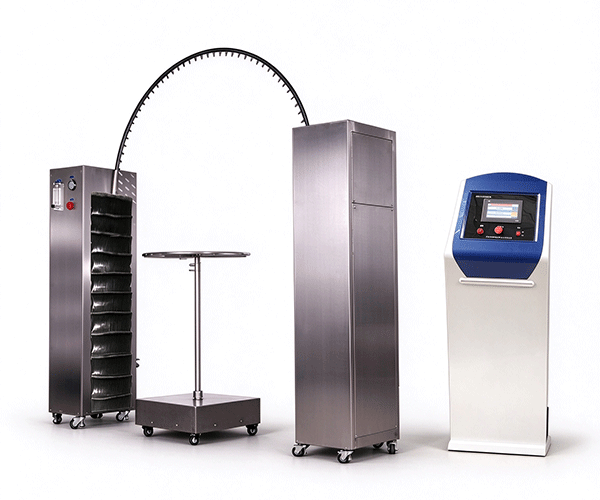
2. How Does the Oscillating Tube Rain Test Work?
The operating principle is simple to understand. Water is supplied to a perforated tube, and the tube oscillates through a defined angle so that water reaches different sides of the test sample. The sample is installed in the prescribed position, and the water exposure is controlled according to the relevant test method.
Although the basic action looks straightforward, a valid test depends on several details. The tube radius, hole arrangement, water flow, oscillation range, test duration, sample position, and support design can all affect how the test is performed. These values must be set according to the applicable standard and the selected equipment configuration. They should not be guessed or copied from an unrelated product setup.
Step 1: Confirm the required test rating
Before operating the apparatus, the user identifies whether the product is being evaluated for IPX3, IPX4, or both. The applicable standard edition and any product-specific requirements should also be confirmed. This step determines the intended exposure conditions and helps the operator select the appropriate test setup.
Step 2: Prepare the sample
The sample should represent the configuration that will be used in service or the configuration specified by the test procedure. Doors, covers, seals, cable entries, connectors, and other components should be installed as required. If the product is normally mounted in a particular orientation, the test plan should identify whether that orientation is required.
Sample preparation is important because even a small change can affect the result. A missing gasket, an incorrectly tightened cover, or an open cable entry may cause water to enter through a route that would not exist in the intended product configuration. On the other hand, extra sealing that is not part of the normal design may give a misleading result.
Step 3: Install the sample and check the apparatus
The operator places the sample on the specified support or fixture and checks that the tube and sample are positioned correctly. The support should not unnecessarily block the water exposure required by the method. The apparatus, water supply, moving parts, and relevant controls should be checked before the test begins.
We discuss fixture requirements during the equipment design stage. A small electrical accessory may need a compact mounting arrangement, while a larger enclosure may require more working space and easier access for loading. The final fixture design depends on the product dimensions, weight, mounting points, and test procedure.
Step 4: Set the water and oscillation conditions
The operator sets the relevant conditions according to the selected test method. These may include water supply and flow, the oscillation range, test duration, and sample positioning. The correct values depend on the test rating and the apparatus configuration. For this reason, we confirm the required technical parameters before manufacturing rather than publishing universal values for every possible configuration.
Step 5: Run the spray test
During the test, the tube moves through the required range while water passes through its spray holes. The motion exposes the sample to water from different directions. The operator monitors the equipment and follows the prescribed procedure, including any requirements for sample repositioning or a second test position.
For IPX3 and IPX4, the details of the procedure matter. The test should not be simplified to “spray water on the product and see what happens.” The exposure conditions must be consistent with the relevant standard, and the sample must be assessed using the correct criteria. Where the applicable procedure specifies a particular orientation, exposure time, or flow condition, the operator must follow that requirement.
Step 6: Inspect the sample after testing
After the water exposure is complete, the operator examines the sample according to the test procedure. Depending on the product and the applicable criteria, this may involve opening the enclosure, checking for water ingress, examining vulnerable components, and assessing whether the water has caused harmful effects. A product continuing to operate immediately after testing does not, by itself, prove that it has passed.
Water may remain in a location where it is not immediately visible, or it may cause corrosion or insulation problems later. The test result therefore needs to be evaluated against the specified acceptance criteria, not only against whether the product powers on. The evaluation should be documented so that engineering and quality teams can review the findings.
Step 7: Record the test result
A useful record includes the sample identification, target rating, applicable test method, relevant operating conditions, observations, and final evaluation. If the product does not meet the requirements, the record can help the manufacturer investigate possible causes such as gasket compression, enclosure joints, connector sealing, or assembly consistency.
At Guangzhou Chuangge Automation Equipment Co., Ltd., we focus on helping customers define a workable test process before the equipment is built. We discuss how samples will be loaded, how the test will be operated, how the results will be inspected, and which documents are required. These practical details can make routine testing easier and reduce confusion between equipment functions and product acceptance requirements.
3. Main Features and Technical Considerations
When selecting an IPX3/IPX4 oscillating tube rain test apparatus, we recommend looking beyond the product name. The most useful configuration is the one that can accommodate the sample, provide the required exposure conditions, and fit the user's daily workflow. A long list of functions is not necessarily helpful if the equipment cannot test the actual product correctly.
Oscillating tube water distribution
The tube is the main working component of the apparatus. Its radius, spray-hole arrangement, movement range, and compatibility with the selected procedure influence how water is distributed around the sample. The tube configuration should be chosen according to the required test conditions and the size of the product being tested.
We recommend confirming the largest sample dimensions early in the project. A sample that is too large for the intended tube arrangement may not receive the required exposure from all specified directions. If customers need to test several product sizes, we review the sample range before recommending a configuration.
Controlled oscillation movement
The tube needs to move through the required range in a controlled manner. The drive and control arrangement should support the test method and allow the operator to run the intended cycle. The exact movement range, cycle timing, and control functions should be stated in the technical proposal and verified according to the agreed acceptance plan.
Suitable sample support
A suitable sample support helps hold the product securely and makes it easier to position the sample correctly. The support should be compatible with the sample's size and weight and should not interfere with the intended water exposure. Depending on the project, the customer may need adjustable mounting points, a particular working height, or a fixture designed for a recurring sample shape.
Water supply and flow requirements
Water supply conditions are central to the test. The required flow depends on the tube configuration and the applicable test procedure. A buyer should confirm the specified flow conditions and how they will be checked or controlled. We do not assume that a single water flow value is suitable for all tube radii or test configurations.
Water handling also deserves attention in the laboratory layout. Users should consider drainage, splash containment, water supply access, and the placement of nearby electrical equipment. The installation area should be appropriate for wet testing, and electrical safety precautions should be followed according to the equipment instructions and local requirements.
Operator-friendly controls
Clear controls help the operator select the intended test cycle and understand the operating status. The functions required will depend on the selected configuration. During technical communication, we clarify which settings need to be entered, which operating conditions need to be displayed, and whether the customer requires additional records or automation.
Practical cleaning and maintenance
Regular cleaning helps prevent mineral deposits, debris, or residue from affecting the water outlets and moving parts. The tube's spray holes should be inspected according to the maintenance instructions, and the water supply should be checked for consistency. Maintenance frequency depends on the water quality, usage frequency, and equipment design.
We also recommend that users establish a routine inspection checklist. The checklist may cover the tube, spray holes, movement mechanism, water supply, sample fixtures, controls, and drainage. If the apparatus shows unusual movement, leakage, blocked holes, or inconsistent water distribution, the cause should be investigated before further testing.
Customization for different products
As a manufacturer specializing in customized testing equipment, we can discuss configurations based on sample dimensions, testing requirements, and laboratory workflow. Depending on the project, this may involve the working area, tube arrangement, sample fixture, control requirements, or other agreed features.
Customization should be defined clearly. Buyers should confirm which functions are included as standard, which require additional engineering, and which are outside the project scope. The final quotation and technical specification should identify the agreed configuration so that equipment inspection and delivery can be managed against the same requirements.
We avoid presenting unconfirmed numerical values as fixed product specifications. Parameters such as tube radius, sample capacity, water flow, oscillation timing, working dimensions, and control accuracy must be confirmed for the actual model. This is especially important when a customer needs to demonstrate compliance with a particular test procedure.
4. IPX3 vs. IPX4: Choosing the Right Rain Test Apparatus
IPX3 and IPX4 are often mentioned together because the oscillating tube method can be used for both ratings when the apparatus and procedure are suitable. However, the two ratings should not be treated as interchangeable. The intended water exposure differs, and the sample must be tested against the relevant acceptance criteria.
IPX3 is generally associated with protection against spraying water at angles up to 60 degrees from the vertical. IPX4 covers splashing water from all directions under the applicable procedure. This distinction matters when a product is expected to face rain, spray, or splashes during normal use.
| Selection factor | What to confirm | Why it matters |
|---|---|---|
| Required IP rating | IPX3, IPX4, or both | Defines the intended water exposure and evaluation criteria |
| Sample size | Maximum width, height, depth, and weight | Helps determine the working area and tube configuration |
| Test method | Oscillating tube or another permitted method | Ensures the selected apparatus fits the applicable procedure |
| Water flow | Required flow conditions for the chosen setup | Supports correct exposure conditions |
| Sample orientation | Mounting position and any required repositioning | Helps avoid incorrect test coverage |
| Control functions | Required movement and test cycle controls | Supports practical and consistent operation |
| Inspection needs | How the sample will be opened and evaluated after testing | Helps define the testing workflow and records |
| Documentation | Operating instructions and project-specific records | Supports training, traceability, and review |
Source: This table is a practical equipment-selection checklist prepared by Guangzhou Chuangge Automation Equipment Co., Ltd. The IP rating definitions are based on IEC 60529 and the IP testing guidance published by TÜV SÜD and TÜV Rheinland. The checklist itself is not a mandatory table from those standards. References: TÜV SÜD and TÜV Rheinland.
Sample size is one of the first things we ask about. A compact device may fit a smaller tube configuration, while a large electrical enclosure may need a larger radius or a different test method. The maximum sample size should not be judged from the outer dimensions alone. The required space for mounting, access, movement, and water exposure also needs to be considered.
Another question is whether the customer needs only IPX3/IPX4 testing or a broader water protection programme. An oscillating tube rain test apparatus is not automatically a substitute for equipment used for water jet or immersion tests. If the product specification includes IPX5, IPX6, IPX7, or IPX8, the corresponding test method and equipment requirements should be reviewed separately.
Customers should also consider how the results will be used. A manufacturer may need the apparatus for product development or routine internal quality control. A third-party laboratory may need to conduct tests for external customers under specific procedures. The required documentation and approval process can differ, so the equipment scope should be matched to the intended use.
5. Applications in Electrical, Electronic, and Industrial Manufacturing
Water ingress protection testing is useful for products whose enclosures may be exposed to rain, spray, or splashing water. The actual risk depends on where the product is installed, how it is used, and how its enclosure is designed. A controlled rain test can help manufacturers find weak points before the product enters routine production or reaches the market.
Electrical enclosures and control cabinets
Electrical enclosures protect internal terminals, wiring, control units, and other components from environmental exposure. Water may enter through door seals, cable glands, cover joints, connectors, or poorly fitted access panels. An IPX3/IPX4 rain test apparatus helps manufacturers evaluate these enclosure features under the specified spray or splash conditions.
Testing can also be useful when a design changes. For example, changing the enclosure material, gasket profile, cable entry, or fastener arrangement may affect water protection. A repeatable test process allows the engineering team to compare the revised design with the previous version, provided the test conditions and sample preparation remain consistent.
Electronic products and components
Electronic products may contain circuit boards, sensors, connectors, displays, and other components that are sensitive to moisture. Water ingress can cause unstable operation, corrosion, or insulation problems. Testing helps manufacturers assess whether the enclosure provides the intended level of protection under the specified conditions.
Not every electronic product requires IPX3 or IPX4 testing. The required rating depends on the product's intended use, applicable standards, and customer specifications. We recommend confirming those requirements before deciding on the equipment configuration.
Household appliances
Some household appliances are used in kitchens, utility rooms, garages, and other environments where splashes may occur. Water protection requirements vary by appliance type and design. Where an IPX3 or IPX4 assessment is relevant, the oscillating tube rain test apparatus can support the evaluation of housing, joints, buttons, and other potential entry points.
Testing should follow the applicable product requirements. If an appliance needs to be powered or operated during a test, that requirement must be confirmed in the test plan and the equipment design. The user should not assume that every rain test is performed with the product energized.
Lighting products and outdoor equipment
Lighting housings and outdoor electrical equipment may experience rain or splashing during installation and use. Water can enter around lens seals, housing joints, mounting interfaces, and cable connections. Testing helps the manufacturer evaluate the enclosure's resistance to the specified exposure and identify areas that need design improvement.
Outdoor use does not automatically mean that IPX4 is the correct rating. Some products may require other water protection levels depending on the installation environment. The correct test should be selected from the product specification rather than from the general description of where the product will be used.
Switches, sockets, and electrical accessories
Switches, sockets, connectors, and electrical accessories may have small openings and multiple interfaces that require careful sealing. Depending on the product's intended environment, water ingress testing may be part of product development or quality inspection. The sample should be assembled and mounted in accordance with the relevant procedure so that the test reflects the actual design.
Automotive and transport-related components
Selected vehicle-related electrical components and transport equipment may require enclosure water protection testing. However, some automotive products are subject to additional standards or customer-specific procedures. Before selecting an IPX3/IPX4 oscillating tube rain test apparatus, the buyer should confirm whether IEC 60529 alone is sufficient or whether another test specification applies.
Testing laboratories and quality inspection departments
Laboratories may use rain test equipment for design verification, sample comparison, incoming inspection, and failure analysis. In these environments, repeatable setup, clear operating instructions, and consistent sample preparation are important. The apparatus should fit the range of samples being tested and the way the laboratory records and reviews its results.
Guangzhou Chuangge Automation Equipment Co., Ltd. supplies customized testing equipment for a range of industries, including construction materials and components, wires and cables, plastics and textiles, electrical plugs, sockets and switches, electronic products, and home appliances. The correct test equipment depends on the application and applicable standard. We review each request according to its actual requirements instead of assuming that one apparatus will suit every product category.
6. Manufacturing, Inspection, Delivery, and Documentation
For customized testing equipment, a clear technical scope is the starting point for manufacturing. We first discuss the target rating, sample size, applicable test procedure, required functions, and installation conditions. Where the customer has drawings, a specification, or a reference test method, these materials help us understand the project more accurately.
Technical review and configuration
During the initial review, we confirm the sample dimensions and the working space needed for loading and testing. We also discuss the tube configuration, required water supply conditions, control functions, sample support, and any special operating requirements. If the customer plans to test several product types, we review the range rather than designing around only one sample without checking future needs.
At this stage, we also clarify what the customer expects from the equipment. Some users need a straightforward apparatus for internal product development. Others require additional functions, particular fixtures, or documentation for a more structured quality inspection process. These needs should be agreed upon before the final quotation and technical specification are approved.
Manufacturing and assembly
After the configuration is confirmed, manufacturing and assembly proceed according to the agreed technical scope. Attention should be given to the tube structure, moving mechanism, water supply arrangement, sample support, controls, and other components included in the design. The exact manufacturing steps and components depend on the selected model and customization requirements.
We do not assume that all customer projects need identical components or options. The equipment configuration is based on the actual application. If a buyer requests a non-standard working area or special fixture, the engineering implications and delivery schedule should be discussed before the order is confirmed.
Functional inspection before delivery
Before delivery, each unit undergoes functional inspection and performance verification according to the agreed scope. The purpose is to check that the included functions operate as intended and that the required verification activities have been completed. Any special acceptance checks should be identified during technical discussions so they can be included in the project plan.
Equipment inspection and product certification are different matters. Functional verification of the apparatus does not mean that every product tested with it will pass IPX3 or IPX4. Product acceptance depends on the sample, test conditions, applicable standard, and evaluation criteria. This distinction is important for manufacturers preparing test records or making claims about their products.
Operating instructions and technical documents
Operating instructions and technical documentation are provided as agreed. These documents help operators understand the equipment's intended use, basic operating sequence, and maintenance requirements. If a customer needs particular document formats, language arrangements, or additional project records, these should be discussed before manufacturing begins.
Production lead time
Our typical production cycle for customized testing equipment is approximately 30 to 60 days. The actual lead time depends on the equipment configuration, engineering requirements, component availability, and project complexity. A customized IPX3/IPX4 oscillating tube rain test apparatus may require a different schedule from a standard configuration, so we confirm the estimated delivery date after the technical scope is agreed.
Packaging and shipping
We can arrange shipment by sea, air, or land according to the destination, schedule, and customer requirements. Protective materials and sturdy wooden cases can be used to reduce the risk of damage during handling and transportation. Packaging should be suitable for the equipment's dimensions, weight, and sensitive components. Shipping terms, destination requirements, and necessary documents are confirmed for each order.
| Project stage | Typical work | Items to confirm |
|---|---|---|
| Requirement review | Review the product, target IP rating, and test method | Sample drawings, dimensions, applicable standard |
| Technical configuration | Define the tube arrangement, support, controls, and working space | Required functions and agreed specifications |
| Manufacturing | Build and assemble the apparatus according to the approved scope | Configuration, schedule, customization details |
| Inspection | Perform functional inspection and agreed verification | Acceptance checklist and required records |
| Delivery | Prepare documentation, packaging, and shipment | Shipping method, destination, delivery terms |
Source: This table summarizes the general project workflow based on the supplied company information. It is not a manufacturing sequence or timetable mandated by IEC 60529. The actual work and acceptance arrangements are confirmed in the project specification.
Payment terms are negotiable and should be agreed upon before the order is placed. For overseas projects, we recommend confirming the equipment scope, inspection requirements, document package, shipping method, packaging, delivery terms, and payment schedule in writing. A clear agreement makes it easier for both parties to manage expectations and avoid unnecessary delays.
7. Why Choose Guangzhou Chuangge Automation Equipment Co., Ltd.?
Selecting a testing equipment supplier involves more than comparing prices. The apparatus must be suitable for the intended test, fit the sample, and support the customer's workflow. If the working area is too small, the fixture is unsuitable, or required control functions have been overlooked, the buyer may face additional work after delivery. We therefore put considerable emphasis on understanding the project before confirming a solution.
Guangzhou Chuangge Automation Equipment Co., Ltd. specializes in customized testing equipment and has a strong focus on standards-related applications. Our products support testing and evaluation across construction materials and components, wires and cables, plastics and textiles, electrical plugs, sockets and switches, electronic products, and home appliances. These applications have different requirements, so we discuss the actual test method and product characteristics for each project.
Our corporate philosophy is to ensure survival through high technology and drive development through high quality. We have obtained ISO 9001 quality management system certification, ISO 14001 environmental management system certification, and ISO 45001 occupational health and safety management system certification. These certifications relate to the company's management systems. They should not be interpreted as product-specific certifications for every apparatus or as proof that a customer's product has achieved a particular IP rating.
Our intellectual property portfolio currently includes more than 20 patents, including invention patents, utility model patents, and software patents. This portfolio reflects our ongoing technical development in testing equipment and related technologies. The actual functions and performance requirements of an individual oscillating tube rain test apparatus are still defined by the project specification.
Customization is useful when the customer's testing needs do not fit a standard configuration. For example, a buyer may need a particular tube radius, a working area suited to a large enclosure, a dedicated fixture, or specific control functions. We review these requests and confirm the feasible configuration, technical scope, and delivery implications before the order is finalized.
We also believe that a useful quotation should make the technical scope understandable. Buyers should be able to identify the included functions, required utilities, sample limitations, inspection arrangements, documents, and delivery terms. If a function is optional or requires additional engineering, it should be stated clearly rather than left ambiguous.
When comparing IPX3/IPX4 oscillating tube rain test apparatus suppliers, we suggest asking the following questions:
Does the proposed equipment support the intended IPX3 and IPX4 test methods?
Are the tube radius, sample dimensions, and working area appropriate for the actual products?
Are the required water supply and flow conditions clearly specified?
Can the sample be mounted in the required position without unnecessary obstruction?
Are the control functions and operating sequence clearly described?
What functional inspection and performance verification will be completed before delivery?
Which operating instructions and technical documents are included?
Are the production cycle, payment terms, packaging, and shipping arrangements confirmed?
These questions help buyers compare quotations on a consistent basis. The lowest initial price may not be the most suitable option if important fixtures, control functions, or acceptance requirements are missing. A clear technical agreement helps both sides understand what will be manufactured, inspected, and delivered.
Our approach is to communicate clearly, review the application carefully, and define the equipment configuration around the customer's requirements. If you provide the target IP rating, sample dimensions, applicable standard, and expected workflow, we can discuss a more relevant proposal for your project.
8. Frequently Asked Questions About IPX3/IPX4 Oscillating Tube Rain Test Apparatus
Q1: What is the difference between IPX3 and IPX4?
IPX3 evaluates protection against spraying water at angles up to 60 degrees from the vertical under the applicable test procedure. IPX4 evaluates protection against splashing water from all directions under its specified conditions. The two ratings have different exposure requirements, so the correct test method and acceptance criteria must be followed for each rating.
Q2: Can one oscillating tube apparatus perform both IPX3 and IPX4 tests?
A suitable apparatus may support both ratings if its tube configuration, water supply, controls, working space, and operating procedure meet the relevant requirements. Buyers should confirm the exact functions and test scope before ordering. The product name alone does not prove that every possible configuration or sample size is supported.
Q3: Which standard applies to IPX3/IPX4 testing?
IEC 60529, Degrees of protection provided by enclosures (IP Code), is a key reference for IP ingress protection testing. However, some products may also have product-specific standards or customer-defined requirements. The applicable edition and procedure should be confirmed before testing and equipment configuration.
Q4: Can the apparatus be used for IPX5 or IPX6 testing?
An oscillating tube apparatus designed for IPX3/IPX4 should not automatically be considered suitable for IPX5 or IPX6. These ratings involve water jet tests with different equipment and test conditions. If the customer needs IPX5 or IPX6, the corresponding equipment requirements should be reviewed separately.
Q5: What product information is needed for a quotation?
We recommend providing the target IP rating, applicable standard or test specification, sample dimensions, sample weight, mounting arrangement, and required operating functions. If the product has several sizes, please identify the largest sample and any special shapes or installation conditions. Drawings and photographs can help us understand the application and propose a suitable configuration.
Q6: Can the equipment be customized for large samples?
Customization can be discussed based on the sample dimensions, weight, mounting requirements, and test method. Larger samples may affect the tube radius, working area, fixture design, and installation requirements. We review these factors before confirming the final configuration and delivery schedule.
Q7: How long is the production cycle?
Our typical production cycle for customized testing equipment is approximately 30 to 60 days. The actual schedule depends on the selected configuration, engineering work, component availability, and project complexity. We confirm the estimated lead time after the technical scope and order requirements have been agreed.
Q8: Does the apparatus automatically determine whether a product passes?
Not necessarily. The apparatus creates the required water exposure conditions, but the product must be inspected and evaluated according to the applicable procedure. Some projects may require additional measurements, functional checks, or documented inspection. The final pass or fail decision depends on the test requirements and the observed results.
Q9: What is checked before shipment?
Each unit undergoes functional inspection and performance verification according to the agreed project scope. Any special acceptance checks should be discussed before manufacturing. The inspection plan should clearly state which functions will be checked and which records will be provided.
Q10: What documents are supplied with the apparatus?
Operating instructions and technical documentation are provided as agreed. If the customer needs particular document formats, languages, or additional records, these requirements should be included in the technical discussion before the order is confirmed.
Q11: Can the apparatus be shipped internationally?
Yes. Transportation can be arranged by sea, air, or land according to the destination and delivery requirements. Protective materials and sturdy wooden cases can be used to help protect the equipment during transport. Shipping terms, packaging details, and required documents are confirmed for each project.
Q12: Does passing IPX4 mean a product is waterproof under all conditions?
No. IPX4 indicates protection against the specified splashing water exposure; it does not establish resistance to every form of water exposure. High-pressure water jets and immersion are assessed under other classifications. Product claims should accurately reflect the ratings and test conditions that have actually been evaluated.
Q13: Can this apparatus be used for formal certification?
The apparatus provides a testing environment, but it does not automatically issue a product certificate. Whether test results can be used for a particular certification or regulatory purpose depends on the applicable scheme, test method, laboratory competence, and required documentation. Customers should confirm formal certification requirements with the relevant certification body or testing organization.
Request a Customized IPX3/IPX4 Oscillating Tube Rain Test Apparatus
If you are looking for an IPX3/IPX4 Oscillating Tube Rain Test Apparatus for water ingress protection testing, Guangzhou Chuangge Automation Equipment Co., Ltd. welcomes your enquiry. We work with customers to understand their products, target ratings, testing procedures, and practical equipment requirements before confirming a suitable configuration.
To help us review your project, please provide the product type, sample dimensions, required IP rating, applicable standard, and any special requirements for the fixture, controls, or documentation. If you already have a customer specification or test procedure, sharing it at the beginning can make technical communication more efficient.
We can then discuss the proposed equipment configuration, customization scope, production cycle, inspection arrangements, packaging, and shipping options. Our typical production cycle is approximately 30 to 60 days, depending on the final requirements. Payment terms are negotiable and can be confirmed during order discussions.
With the correct test method and a clearly defined equipment configuration, manufacturers can evaluate water ingress protection more systematically, identify potential enclosure weaknesses, and make better-informed design and quality decisions. Contact Guangzhou Chuangge Automation Equipment Co., Ltd. to discuss your IPX3/IPX4 rain testing requirements and request a project-specific quotation.
Technical References
International Electrotechnical Commission (IEC), IEC 60529, Degrees of protection provided by enclosures (IP Code). Refer to the applicable edition for the complete test procedures and acceptance requirements.
TÜV SÜD, Ingress Protection (IP) Testing: IP testing overview.
TÜV Rheinland, IP Testing: IP code classifications and testing guidance.
Japan Quality Assurance Organization (JQA), IP Waterproof Testing: Examples of IP water test methods and sample capacity considerations.
Note: This page provides general product information. The final apparatus configuration, test procedure, and acceptance criteria should be confirmed against the applicable standard edition and the customer's product-specific requirements.
