Anti-Cracking Winding Machine for Reliable Wire And Cable Winding Applications
1. Product Overview: Why Anti-Cracking Winding Matters in Wire and Cable Production
In wire and cable manufacturing, winding may look like a simple job: guide the cable onto a reel, keep it organized, and prepare it for storage or delivery. In actual production, however, the process requires much more attention. If the cable is pulled too tightly, bent too sharply, or wound unevenly, its insulation and outer jacket may be damaged. Some cables can also become difficult to handle when the material is cold, stiff, or sensitive to repeated bending.
At Guangzhou Chuangge Automation Equipment Co., Ltd., we understand that industrial equipment needs to be selected according to the material, the process, and the intended result. Our company specializes in customized testing equipment for applications involving wires and cables, plastics, textiles, construction materials, electrical accessories, electronic products, and household appliances. This experience gives us a practical perspective on material behavior, technical requirements, and the importance of defining measurable acceptance criteria.
The Anti-Cracking Winding Machine for Reliable Wire and Cable Winding Applications is intended as a product concept for cable winding operations where preventing avoidable surface damage and material cracking is an important concern. The purpose of such equipment is to support controlled winding, orderly cable arrangement, and suitable handling throughout the winding process. The precise machine structure, available controls, compatible cable types, and performance limits must be confirmed against the final product specification.
It is worth making one point clear from the beginning: a winding machine cannot guarantee that every cable will remain crack-free under every condition. Cracking can result from material formulation, aging, unsuitable storage, temperature, excessive bending, mechanical damage, or other factors. A well-matched winding arrangement can help reduce handling-related risks, but it cannot replace correct cable design, appropriate material selection, or formal product testing.
For manufacturers, cable processors, and industrial buyers, the real objective is to find a winding solution that matches the cable's mechanical properties and production requirements. This means looking beyond the machine name. Cable diameter, jacket material, minimum bending radius, reel dimensions, winding tension, line speed, and the required coil arrangement should all be considered before choosing equipment.
In this article, we explain how anti-cracking cable winding works in practical terms, which factors may contribute to cracking, how to evaluate winding equipment, and what information should be confirmed before ordering. We also explain how we approach technical communication, customization requirements, inspection, and delivery at Guangzhou Chuangge Automation Equipment Co., Ltd.
2. Understanding the Winding Process and the Causes of Cable Cracking
2.1 What happens during cable winding?
Winding is the process of arranging wire or cable around a reel, drum, spool, or another suitable carrier. The aim is to form a stable coil that can be stored, transported, installed, or transferred to the next production stage. Depending on the product, winding may take place after extrusion, cooling, inspection, cutting, or another manufacturing operation.
During winding, the cable follows a curved path while being pulled forward and placed onto a rotating reel or winding surface. The cable experiences tension along its length and bending as it changes direction. If the cable is guided poorly or the reel geometry is unsuitable, some areas may experience more stress than others.
For example, a cable wound under excessive tension may be compressed tightly against neighboring turns. If the cable is also bent below its permitted minimum radius, the insulation or outer jacket may be exposed to unnecessary mechanical strain. Uneven winding can produce crossed turns, local pressure points, or a coil that is difficult to unwind smoothly.
These issues do not affect every cable in the same way. A flexible control cable, a thick power cable, a small insulated wire, and a cable with a multilayer construction can respond differently to the same winding conditions. This is why we recommend evaluating the actual material instead of assuming that one winding setting will work for every product.
2.2 Common reasons for cracks and surface damage
Cracking is a material failure in which a visible split or fracture develops in an insulation layer, sheath, or other component. The cause may be related to the material itself or to the way the cable is handled. In a production environment, several factors can contribute to the problem.
Excessive winding tension: Too much pulling force can stretch, compress, or otherwise stress cable components, depending on the construction and winding geometry.
Insufficient bending radius: A tight bend may place excessive strain on the outer surface or other parts of the cable structure.
Low-temperature handling: Some insulation and jacket materials become stiffer or more brittle in cold conditions. Their handling limits depend on the material and product specification.
Uneven cable guidance: Poor alignment can cause crossed turns, concentrated pressure, and irregular coil formation.
Material aging or degradation: Exposure to heat, ultraviolet radiation, chemicals, or long-term environmental conditions may change the flexibility of some materials.
Existing manufacturing defects: A cable with an existing defect may crack during winding even when the machine is operating within its intended range.
These are possible contributing factors, not a diagnosis of every crack. When a problem occurs, the user should examine the damage location, cable construction, storage conditions, winding settings, and any recent process changes. A repeatable investigation is more useful than simply lowering the machine speed and assuming the problem has been solved.
2.3 The role of tension control
Winding tension is the pulling force applied to the cable as it moves onto the reel. It must be high enough to keep the cable under control and form a stable coil, but not so high that the cable is unnecessarily stressed. The suitable tension depends on cable construction, diameter, material, reel size, and the desired coil structure.
Some winding systems use mechanical arrangements to manage tension, while others may use sensors, electronic controls, or feedback systems. These are different design approaches, and the actual configuration available on a particular anti-cracking winding machine must be confirmed with the supplier.
When evaluating a machine, we recommend asking how tension is set, whether it can be adjusted during operation, and how the system responds when reel diameter changes. If the cable is delicate or its properties vary between batches, it may also be useful to discuss whether tension monitoring or a documented setup procedure is required.
There is no universal tension value suitable for every wire and cable. Any numerical setting should be established using the cable manufacturer's requirements, engineering calculations where applicable, and trials with representative material. A setting that works for one cable may damage another.
2.4 Why bending radius matters
The bending radius describes the size of the curve through which the cable passes. A smaller radius means a tighter bend. When the radius is too small for a particular cable, the outer jacket and internal components may experience excessive strain, while other parts of the cable may be compressed or displaced.
Different cable designs have different bending requirements. A flexible cable designed for repeated movement is not automatically equivalent to a power cable intended for fixed installation. Cable diameter alone is not enough to establish the correct radius. The manufacturer may specify a minimum bending radius based on construction, installation conditions, or whether the cable is moving or stationary.
For this reason, we recommend checking the cable datasheet before selecting a reel or winding path. The reel diameter, guide roller geometry, and any direction changes should be reviewed against the cable's specified limits. Where a project covers several cable types, the design may need to accommodate the most demanding material or use different setup recipes for different products.
2.5 Material condition before winding
The cable's condition before winding can be just as important as the machine itself. A cable that has been stored in an unsuitable environment, exposed to chemicals, damaged during transport, or handled outside its temperature limits may not behave as expected during winding.
For example, cable handling guidance published by Fujikura Dia Cable warns that excessive impact can reduce cable performance and that some vinyl-insulated wires can become brittle under cold conditions. The guidance also emphasizes avoiding excessive pulling tension and excessive bending during cable installation and handling. These principles are relevant to winding-process planning, although the exact limits for a specific cable must come from its own documentation.
Reference: Fujikura Dia Cable — How to Handle Electric Wires And Cables.
Before winding, users should therefore check whether the material has reached the permitted operating temperature, whether the cable surface is intact, and whether the product has been stored according to its manufacturer's recommendations. A winding machine should be treated as one part of a controlled production process, not as a way to compensate for every upstream problem.
2.6 Comparison table: common cracking risks and practical controls
| Potential risk | Possible effect | Practical control to consider |
|---|
| Excessive pulling tension | Unnecessary stress or deformation during winding | Establish a suitable tension range using cable specifications and representative trials |
| Tight bends | Excessive strain on the jacket or internal cable components | Check minimum bending radius and review reel and guide geometry |
| Cold or unsuitable storage conditions | Reduced flexibility or increased risk of brittle damage for sensitive materials | Follow the cable manufacturer's storage and temperature guidance |
| Uneven guiding or crossed turns | Local pressure, irregular coils, and difficult unwinding | Review guide alignment, traverse arrangement, and winding setup |
| Existing material defects | Cracks may appear even when winding settings are suitable | Inspect incoming cable and investigate defects by batch and location |
Sources: Fujikura Dia Cable's cable handling guidance discusses tension, bending, impact, and cold-weather handling. Southwire's wire and cable handling and storage guidelines also provide general handling precautions. The control column is a practical summary, not a guarantee that any machine will eliminate cracking.
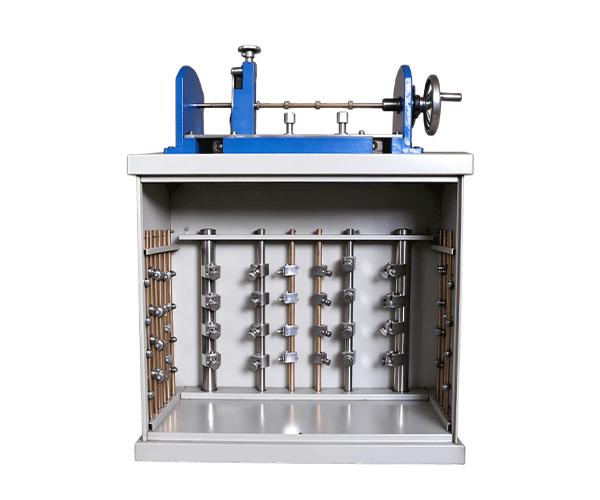
3. Key Features and Technical Factors to Evaluate
3.1 A winding arrangement suited to the cable
A suitable winding machine should be evaluated according to the cable it needs to handle. Important details include cable diameter, construction, flexibility, surface material, required coil dimensions, and the shape of the receiving reel. These details determine the range of operating conditions that the equipment needs to support.
For an anti-cracking winding application, the cable path deserves particular attention. The path should guide the material without forcing it through unnecessary sharp turns or creating avoidable contact with rough surfaces. Guide rollers and contact points, where used, should be suitable for the cable dimensions and surface requirements. The exact design depends on the machine configuration.
We recommend providing a cable sample or a clear technical datasheet when discussing equipment. A short description such as "soft cable" or "crack-resistant wire" does not provide enough information for reliable engineering decisions. The supplier should understand the actual material, the intended production conditions, and the result that the buyer expects to achieve.
3.2 Adjustable winding tension
Different cables may require different tension settings. A machine intended for a broad range of products should therefore be assessed for its adjustment method and operating range. Depending on the design, tension may be controlled through mechanical adjustment, a braking arrangement, a drive system, or another suitable method.
Buyers should confirm whether the tension setting is manual or automatic, how operators know that the selected setting is being maintained, and whether the arrangement remains suitable as the reel fills. If the equipment does not include direct tension measurement, the operating procedure may need to specify how the setting is established and verified.
We also recommend checking whether the equipment supports repeatable settings for different product types. If operators regularly change between cable diameters or materials, documented recipes or setup records can reduce unnecessary trial and error. Such features should be confirmed as part of the agreed specification rather than assumed from the term "anti-cracking."
3.3 Controlled winding speed
Winding speed affects production output, but faster operation is not always better. If cable feeding, guiding, or reel movement cannot keep up with the selected speed, the cable may become loose, cross over itself, or experience changing tension. A suitable operating speed is one that meets production needs while maintaining the required winding quality.
For this reason, the requested speed range should be considered alongside the cable type and coil dimensions. If the production line already includes an extrusion line, a measuring station, or a take-up system, the winding machine may need to coordinate with the speed of the upstream equipment. In an independent winding station, the operating requirements may be different.
When comparing suppliers, ask whether the quoted speed refers to an unloaded machine, a particular cable, or a demonstrated production condition. Also confirm whether speed adjustment is available and whether the machine can maintain stable winding as operating conditions change. These details make performance claims more useful for production planning.
3.4 Uniform coil formation
A well-formed coil is easier to store, transport, inspect, and unwind. Uniform winding helps keep cable turns organized and can reduce the risk of tangled sections or local pressure caused by overlapping turns. Depending on the machine design, coil formation may involve a traverse mechanism that moves the cable guide across the reel width.
The required coil pattern depends on the product and downstream use. Some applications require a particular reel width or outside diameter, while others prioritize compact packaging or smooth pay-off during installation. The buyer should specify these requirements before choosing the winding equipment.
We recommend defining coil acceptance criteria in practical terms. These may include reel dimensions, winding direction, cable length, the appearance of the finished coil, and any special requirements for the cable end. If the coil must feed directly into another machine, the receiving equipment's requirements should also be considered.
3.5 Cable surface protection
The cable's outer surface may be sensitive to scratching, abrasion, pressure marks, or contamination. During winding, damage can occur when the cable rubs against unsuitable guides, reel edges, or neighboring components. The effect depends on the jacket material and the condition of the contact surfaces.
For applications with delicate insulation or finished outer jackets, buyers should ask how the cable contacts the equipment and whether the contact surfaces are suitable for the intended material. The design should also allow operators to inspect accessible components for wear, sharp edges, or accumulated debris.
Surface protection should not be described as a guaranteed outcome without testing. The appropriate approach is to run representative material under agreed conditions and inspect the cable before and after winding. If the product has strict cosmetic or electrical requirements, those requirements should be included in the acceptance procedure.
3.6 Operation, maintenance, and safety
Ease of operation matters because winding machines are often used repeatedly throughout a production shift. Operators should be able to understand the setup procedure, confirm the reel is correctly installed, follow the threading route, and respond safely when the line stops or the cable behaves abnormally.
Depending on the actual configuration, useful items to confirm may include accessible controls, speed adjustment, emergency stopping, protective guards, and instructions for reel changeover. These features must be checked against the final machine specification. They should not be presented as confirmed standard features when the product details have not yet been supplied.
Maintenance planning should cover routine inspection of moving parts, guide surfaces, drive components, and electrical connections as applicable. Cleaning and servicing must follow the manufacturer's instructions. Before workers clear a jam or perform maintenance near hazardous moving components, the equipment should be stopped and isolated from hazardous energy sources according to the site's procedures.
The U.S. Occupational Safety and Health Administration explains that machine guarding is intended to protect workers from hazards created by moving machine parts, including rotating components and ingoing nip points. Its guidance is a useful reference for machinery safety planning, although applicable legal obligations depend on the installation location.
Reference: OSHA Machine Guarding — General Requirements.
3.7 Comparison table: winding equipment selection priorities
| Requirement | Basic evaluation | More detailed evaluation | Information to confirm |
|---|
| Tension management | Operators can set a suitable winding condition | Repeatability and response to changing reel diameter are evaluated | Adjustment method, measurement method, and operating range |
| Cable guidance | The cable follows a stable path onto the reel | Guide geometry is checked for different cable sizes and surface types | Compatible diameter range and contact-surface details |
| Speed control | The machine operates at the required production speed | Speed stability is checked under representative loading conditions | Speed range and the conditions behind stated performance figures |
| Coil formation | The cable is wound and collected in an orderly way | Traverse pattern and finished coil dimensions are verified | Reel size, coil width, winding pattern, and acceptance criteria |
| Maintenance and safety | Routine checks and safe shutdown procedures are available | Access, guarding, isolation procedures, and line integration are reviewed | Safety provisions, manuals, training, and maintenance requirements |
Source: This table is a buyer's evaluation framework based on general cable-handling principles from Fujikura Dia Cable's handling guidance and machinery safeguarding principles from OSHA. It is not a comparative test of specific winding machine models. Actual functions and measurable ranges must be confirmed with the manufacturer.
4. Applications of an Anti-Cracking Winding Machine
4.1 Wire and cable manufacturing
Wire and cable manufacturers often need to collect finished or semi-finished products after extrusion, cooling, inspection, or another production operation. The winding station must match the cable dimensions, line speed, and required reel format. If the product has a sensitive jacket or a limited bending radius, the winding arrangement should be checked carefully.
An anti-cracking winding solution may be considered where the production team wants to reduce handling-related damage and improve consistency between coils. The actual benefit depends on the existing process and the machine configuration. A winding machine cannot correct a material formulation issue or an insulation defect created earlier in production.
For a manufacturer handling several cable families, it is useful to document the setup conditions for each product. This may include reel dimensions, cable path, tension settings, speed, and inspection requirements. A documented setup makes it easier to identify whether a change in the process is associated with an increase in visible damage.
4.2 Electrical power cable production
Power cables can vary considerably in diameter, construction, conductor material, insulation, and outer sheath. Some are relatively flexible, while others are designed for fixed installation and have specific handling limits. A winding system should be selected according to the actual cable specification rather than the general category of "power cable."
For larger or heavier cable products, reel capacity, support structure, loading arrangements, and the cable's minimum bending radius may be especially important. Buyers should also confirm whether the winding station is intended for an individual reel or needs to coordinate with a larger line. The final machine layout and operating limits must be established from the project requirements.
4.3 Telecommunications and data cables
Telecommunications and data cables may have smaller diameters, multiple internal elements, shielding, or specialized jacket materials. Some products are designed to tolerate repeated flexing, while others are intended for a more controlled installation environment. These differences affect how the cable should be guided and wound.
For such applications, an organized winding pattern and appropriate handling conditions can help reduce tangles and unnecessary mechanical stress. The supplier should understand the cable construction, required reel format, and whether the cable will be used in a subsequent pay-off process. If electrical or signal performance is sensitive to mechanical damage, inspection criteria should reflect the product's actual requirements.
4.4 Flexible wires and specialty cables
Flexible wires, instrument cables, control cables, and other specialty products may have specific requirements for bend radius, surface protection, or coil dimensions. Some are used in equipment where cable flexibility and reliable insulation are important throughout the product's service life.
For these products, it is worth testing the winding process using representative samples before approving a machine configuration. Inspect the cable after winding and, where appropriate, after unwinding. If the application requires electrical verification, it should be performed using a suitable test method and the relevant product acceptance criteria.
Our company specializes in customized testing equipment across several industrial fields, including wires and cables. Where a project also requires testing equipment to evaluate material or cable properties, those requirements should be specified separately. A winding machine and a testing instrument perform different functions, and neither should be assumed to replace the other.
4.5 Cable processing and packaging facilities
Cable processors, distributors, and packaging facilities may need to rewind products into customer-specified lengths or reel formats. In these operations, consistent winding can improve handling and make the finished product easier to transport or use. The machine must match the incoming cable and the required finished package.
Buyers should confirm how the cable is loaded, how the finished reel is removed, and whether the process includes length measurement, cutting, labeling, or packaging. These functions may be handled by separate equipment, depending on the project. If the winding machine is expected to integrate with other equipment, the scope and control interfaces should be agreed in advance.
4.6 Quality inspection and production support
In some factories, winding is closely connected with product inspection. The cable may need to pass through an inspection stage before it is collected on a reel, or the finished coil may need to be checked before packaging. In this case, the winding station should be planned around the entire workflow.
Quality teams may monitor visible surface damage, coil dimensions, cable length, and other product-specific characteristics. The appropriate checks depend on the cable type and the manufacturer's quality plan. If the objective is to identify cracking, a visual check may be useful but may not be sufficient to establish every aspect of cable integrity.
Where formal material testing is required, the relevant method and acceptance criteria must be selected according to the product and applicable standard. The winding process itself is not a substitute for testing the insulation material or proving electrical performance.
5. Manufacturing, Customization, Quality Inspection, and Delivery
5.1 Understanding the project before selecting equipment
At Guangzhou Chuangge Automation Equipment Co., Ltd., our work focuses on customized testing equipment and technical solutions for industrial applications. We serve sectors that include wires and cables, plastics, textiles, construction materials, electrical accessories, electronic products, and household appliances. Our approach is to understand the requirement first and then clarify the equipment scope, relevant technical conditions, and acceptance expectations.
For an anti-cracking winding machine inquiry, the first step is to confirm the exact product and the available configuration. We would need to understand the cable type, diameter range, jacket material, minimum bending radius, required reel dimensions, expected production speed, and operating environment. If the project includes tension control, length measurement, automatic traverse, or integration with another machine, those functions should be identified separately.
This information is important because the product name alone does not define the machine's capabilities. A reliable quotation should describe the equipment configuration, included accessories, relevant performance values, installation requirements, and any limitations. It should also explain which features are standard and which require customization.
5.2 Customization based on real production requirements
Customization can be useful when the customer's cable dimensions, production layout, or workflow differs from a standard arrangement. However, customization should be based on defined requirements rather than general requests such as "make it more efficient" or "prevent all cracking."
Useful information may include cable drawings or datasheets, photographs, sample reels, current winding conditions, the observed damage pattern, target coil dimensions, and the available floor space. If the problem is existing cracking, photographs showing where the damage occurs can help identify whether the issue is concentrated at the cable surface, at a bend, near the reel core, or at a particular process stage.
For projects involving more than one cable type, we recommend listing the product range and identifying the most demanding operating condition. The equipment provider can then review whether one configuration can cover the range or whether separate setups are needed. Any proposed adjustment range should be supported by the final specification.
5.3 Quality management and technical communication
Our company follows the philosophy of ensuring survival through high technology and driving development through high quality. We have obtained ISO 9001 quality management system certification, ISO 14001 environmental management system certification, and ISO 45001 occupational health and safety management system certification.
These certifications relate to management systems and should not be interpreted as automatic product-specific certification for every winding machine. If the customer requires a particular product approval, independent test report, or third-party certification, the requirement should be identified and verified separately for the relevant equipment.
Our intellectual property portfolio includes more than 20 patents, covering invention patents, utility model patents, and software patents. The relevance of any individual patent depends on the specific technology and design. We do not assume that every patent applies to every product configuration.
For an equipment project, clear communication means confirming the technical scope, documenting important decisions, and ensuring that both parties understand what will be delivered. If a particular tension range, winding speed, coil size, or damage-related acceptance criterion is important, it should be included in the agreed technical documentation.
5.4 Functional inspection and performance verification
Before delivery, inspection should follow the agreed project scope. Depending on the confirmed machine design, the inspection may include checking the equipment configuration, reviewing electrical functions, confirming the operating sequence, and verifying the relevant winding functions.
If the customer needs to verify anti-cracking performance, the test should be designed around representative cable samples and clearly defined conditions. Useful details include the cable specification, initial material condition, winding tension or setting, reel dimensions, speed, number of winding cycles if applicable, and the method used to inspect the finished cable.
The acceptance criteria should distinguish visible surface damage from other cable properties. A cable may look undamaged while still requiring electrical or material testing for a particular application. Conversely, a visible mark does not always establish the exact cause of a defect. If the application requires electrical performance verification, that work should use the appropriate test equipment and methods.
Formal calibration and third-party certification are different from routine functional inspection. They should only be claimed where the relevant service or approval has actually been provided and documented. The inspection records and technical documents supplied with an order should be confirmed before production is completed.
5.5 Production lead time and order planning
Production time depends on the equipment scope, component availability, customization needs, and the inspection requirements agreed with the customer. For our customized testing equipment projects, the typical production cycle is approximately 30 to 60 days. This is general company information and should not be treated as a guaranteed lead time for every anti-cracking winding machine. The actual schedule must be confirmed for the specific product and order.
To avoid unnecessary delays, buyers should confirm the cable specifications, reel dimensions, electrical requirements, installation conditions, and requested documents as early as possible. Late changes to these items can affect design, procurement, assembly, and inspection. The quotation or contract should identify the delivery schedule and the conditions that may affect it.
5.6 Packaging, shipping, and commercial terms
Industrial equipment needs suitable protection during storage, handling, and transport. Packaging should be selected according to the machine's dimensions, weight, construction, exposed components, and shipping route. Protective materials and sturdy wooden cases may be used where appropriate to reduce the risk of impact and transport damage.
Shipping may be arranged by sea, air, or land depending on the destination, delivery schedule, budget, and applicable transport requirements. Before dispatch, the buyer and supplier should confirm delivery terms, shipping responsibilities, documentation, destination details, and any special handling needs.
Payment terms are negotiable according to the order requirements. We recommend confirming payment milestones, the technical specification, inspection arrangements, packaging, shipping terms, and the agreed delivery date in writing. A clear contract helps both sides understand the commercial and technical responsibilities of the project.
6. Why Choose Guangzhou Chuangge Automation Equipment Co., Ltd.?
6.1 A technical approach to industrial equipment
Industrial buyers often need to solve a specific production problem rather than purchase a machine based only on its name. The challenge may involve material handling, repeatability, process integration, inspection requirements, or the need to document a result. Our focus on customized testing equipment means that we are familiar with projects where requirements need to be clarified before an equipment solution can be evaluated.
For wire and cable applications, we encourage customers to describe the actual issue. If cracking occurs during winding, the useful starting point is to identify the cable construction, the damage location, the environmental conditions, and the existing winding settings. This provides a stronger basis for a technical discussion than simply requesting a machine that promises to prevent cracking.
We also recognize the importance of distinguishing between equipment functions. A winding machine arranges cable on a reel. A material-testing instrument evaluates a defined property using a specified method. If a project requires both functions, they should be planned as separate but potentially coordinated parts of the production and quality process.
6.2 Quality and management systems
Our company has ISO 9001, ISO 14001, and ISO 45001 management system certifications. These systems address quality management, environmental management, and occupational health and safety management respectively. They reflect the management frameworks adopted by the company, but they should not be used as a substitute for verifying the specific performance or certification status of an individual machine.
We also maintain a patent portfolio of more than 20 patents across invention, utility model, and software categories. Customers who need information about a particular patented feature should request the relevant details for the product in question. This is the appropriate way to establish whether a specific technology applies to a particular configuration.
6.3 Clear specifications and practical acceptance criteria
We believe a good equipment project should have a clear technical basis. The buyer and supplier should agree on the material to be processed, the required functions, the operating range, the supplied accessories, the documents, and the inspection procedure. This is especially important when a project uses a performance term such as "anti-cracking," because the term needs to be translated into observable and measurable acceptance conditions.
For example, if the objective is to reduce visible jacket cracking during winding, the test should identify the cable type and the inspection method. If the concern is also electrical integrity, a separate electrical test may be required. If the objective is simply to achieve a consistent coil, the acceptance criteria should focus on the finished winding pattern and dimensions.
When requirements are clearly defined, it becomes easier to compare quotations, evaluate the proposed configuration, and avoid misunderstandings during delivery. We encourage customers to ask questions and confirm the details before placing an order.
6.4 Support for international industrial customers
Industrial purchasing often involves several departments, including engineering, production, quality, procurement, and logistics. Each group may need different information. Engineering may focus on cable dimensions and operating conditions, production may care about setup and cycle time, quality may need inspection records, and procurement may need a clear quotation and delivery plan.
We recommend bringing these requirements together early in the project. If the equipment will be installed overseas, the customer should also confirm the electrical supply, language requirements for documents, local safety rules, installation arrangements, and shipping conditions. These details can affect the final configuration and delivery planning.
Our aim is to support a practical, well-defined equipment discussion. We do not recommend selecting a machine based on unsupported promises. Instead, the technical scope should be confirmed, the relevant performance claims should be defined, and the acceptance process should be agreed before the order is finalized.
7. Frequently Asked Questions About Anti-Cracking Winding Machines
Q1. What is an anti-cracking winding machine?
An anti-cracking winding machine is a winding solution intended for applications where reducing handling-related damage to wire or cable is an important objective. Depending on the actual design, the relevant factors may include cable guidance, winding tension, reel geometry, speed adjustment, and coil formation. The available functions and compatible materials must be confirmed in the product specification.
Q2. Can an anti-cracking winding machine completely prevent cable cracks?
No machine should be assumed to eliminate every possible cause of cracking. Cracks may result from material formulation, aging, unsuitable storage, low-temperature handling, excessive bending, mechanical damage, or manufacturing defects. A suitable winding arrangement can help reduce process-related risks, but the result depends on the cable and operating conditions.
Q3. Which cables can be processed?
Compatibility depends on the actual machine configuration and the cable's construction. Important factors include diameter, jacket material, flexibility, minimum bending radius, reel dimensions, and the required winding pattern. Buyers should provide cable datasheets or representative samples and obtain confirmation of the accepted material range before ordering.
Q4. How do I know the correct winding tension?
The correct tension depends on the cable type, dimensions, construction, and reel arrangement. It should be established using the cable manufacturer's guidance and verified under representative operating conditions. There is no single tension setting that is suitable for every cable. If the machine provides adjustable or monitored tension, the available range and measurement method should be confirmed.
Q5. Does winding speed affect cracking?
It can affect the handling process. A speed that is too high for the cable path or the line configuration may contribute to unstable feeding, uneven winding, or changing tension. However, speed alone does not determine whether a cable will crack. The suitable operating range should be established according to the cable specification, equipment design, and actual production requirements.
Q6. Why is minimum bending radius important?
Minimum bending radius defines how tightly a cable can be bent under specified conditions. A bend that is too tight may create excessive mechanical strain and damage the cable structure. The required radius varies by cable design, so buyers should consult the cable manufacturer's datasheet rather than estimate it from the cable diameter alone.
Q7. Can the machine be customized for different reel sizes?
Customization may be possible depending on the equipment design and project scope. Before requesting a quotation, provide the reel diameter, width, loading method, required finished coil dimensions, cable range, and available floor space. The supplier should confirm which reel sizes and adjustment ranges are supported by the proposed configuration.
Q8. What should I do if cracking already occurs in production?
First, document the problem. Record the cable type, batch, operating conditions, winding settings, storage conditions, and the location of the visible damage. Check whether cracks appear before winding or only after winding or unwinding. Review cable guidance, tension, bending radius, surface contact, and temperature. If the cause remains unclear, arrange a controlled investigation with the cable manufacturer and relevant quality personnel.
Q9. How should anti-cracking performance be verified?
Define the test conditions before evaluating the result. Use representative cable samples and record the material specification, winding setup, operating speed, tension setting where measurable, and inspection method. Establish what counts as acceptable surface condition and whether additional electrical or material testing is required. A general visual demonstration should not be treated as proof of every aspect of cable integrity.
Q10. Is an anti-cracking winding machine a cable testing instrument?
Not necessarily. A winding machine is intended to wind and collect cable, while a testing instrument evaluates a particular property according to a defined method. If the project needs to check insulation thickness, mechanical properties, electrical performance, or resistance to cracking under a specified test condition, suitable testing equipment and methods must be selected separately.
For example, IEC 60811-509 addresses a heat-shock test method for evaluating the resistance of cable insulation and sheathing compounds to cracking at elevated temperature. This is a material test method, not a specification that automatically certifies an anti-cracking winding machine.
Reference: IEC 60811-509 — Electric and optical fibre cables: Test methods for non-metallic materials, resistance of insulation and sheaths to cracking.
Q11. How long does production take?
The production schedule depends on the confirmed machine configuration, customization requirements, component availability, and inspection scope. Our general customized testing equipment projects typically take around 30 to 60 days. This is not a guaranteed lead time for every winding machine. The actual schedule should be confirmed in the quotation or sales contract.
Q12. What documents should be provided with the machine?
The document package should be agreed before production is finalized. Depending on the order, it may include operating instructions, maintenance guidance, electrical information, an equipment list, inspection records, and relevant technical documents. The buyer should confirm the required language, format, and document scope in writing.
Q13. How is the machine shipped?
Shipping options may include sea, air, or land transport, depending on the destination, schedule, cost, and applicable requirements. Protective materials and sturdy wooden cases may be used where appropriate. The parties should confirm packaging, shipping terms, delivery responsibilities, and required documents before dispatch.
Q14. What information should I send to request a quotation?
Provide the cable type, diameter range, jacket material, minimum bending radius if specified, reel dimensions, target coil format, required operating speed, expected production volume, and site conditions. If cracking is already a problem, include photographs, sample details, and the current winding settings. Also identify any required tension control, measurement functions, line integration, inspection records, and delivery requirements.
Conclusion: Build a Winding Process Around the Cable, Not Just the Machine
An Anti-Cracking Winding Machine for Reliable Wire and Cable Winding Applications should be evaluated as part of a complete cable-handling process. Tension, bending radius, winding speed, guide geometry, reel dimensions, storage conditions, and material quality can all affect the final result. A machine that fits the actual cable and production requirements is more useful than a product selected on the strength of a broad marketing claim.
At Guangzhou Chuangge Automation Equipment Co., Ltd., we focus on customized industrial testing equipment and technical communication. Our experience across wire and cable, plastics, textiles, construction materials, electrical accessories, and other industrial applications encourages us to approach equipment projects by clarifying the material, defining the intended result, and agreeing on practical inspection criteria.
If you are evaluating an anti-cracking cable winding solution, we recommend preparing the cable datasheet, reel dimensions, current process conditions, and the specific problem you want to solve. If cracks are already appearing, include the damage location and operating history. These details provide a useful starting point for confirming the appropriate equipment configuration and the verification method.
Contact Guangzhou Chuangge Automation Equipment Co., Ltd. to discuss your wire and cable winding requirements, equipment scope, customization needs, inspection expectations, and delivery arrangements. We can review the information you provide and clarify the next steps for evaluating a suitable solution, subject to confirmation of the specific product configuration and supply scope.
References and Further Reading
Technical note: The article describes general winding and cable-handling principles. It does not establish the exact specifications, available functions, performance values, certification status, or test results of a particular machine. Those details must be confirmed in the final technical proposal and sales contract. IEC 60811-509 concerns a specified cable material test and should not be interpreted as a certification of the winding machine.


