What Is the Difference Between SBI Testing and Fire Resistance Testing?
1. Introduction: Understanding Two Important Fire Testing Methods
Fire safety is an important consideration in the design, manufacture, and selection of construction products and building components. Different materials and building elements behave differently when exposed to fire. Some may contribute to fire development by releasing heat and smoke, while others are designed to prevent fire and hot gases from spreading between building spaces for a specified period.
To evaluate these characteristics, laboratories use different fire testing methods. Two commonly discussed methods are SBI Testing and Fire Resistance Testing. Although both are related to building fire safety, they evaluate different aspects of fire performance and should not be treated as interchangeable.
SBI Testing stands for Single Burning Item Testing. It is a reaction-to-fire test method associated with EN 13823. It evaluates how applicable construction products respond when exposed to a controlled burner, including their heat release, smoke production, and fire growth behavior.
Fire Resistance Testing, on the other hand, evaluates how a building element performs when exposed to specified fire conditions. Depending on the type of element and applicable test standard, the assessment may examine load-bearing capacity, integrity, and insulation performance over a defined period.
Understanding the difference between SBI Testing and Fire Resistance Testing helps manufacturers, construction product suppliers, engineers, and laboratories select appropriate testing methods. This article explains their purposes, procedures, equipment, applications, and key differences.
2. What Is SBI Testing?
SBI Testing is a reaction-to-fire test used to evaluate the fire behavior of applicable construction products. The method is commonly associated with EN 13823 and is intended to assess how a product contributes to fire development under specified laboratory conditions.
During an SBI test, a specimen arrangement is exposed to a controlled burner. The testing equipment collects combustion products through an exhaust system and measures relevant parameters associated with heat release and smoke production.
Unlike a simple visual flame observation, SBI Testing provides quantitative measurement data. This allows laboratories to evaluate different aspects of the specimen's reaction to fire.
2.1 Main Objectives of SBI Testing
The primary purpose of SBI Testing is to understand how a construction product reacts when exposed to a defined fire source.
The test can provide information about:
Fire growth behavior.
Heat Release Rate.
Total heat release.
Smoke production development.
Total smoke production.
Flame spread and other relevant observations.
Flaming droplets or particles, where applicable to the evaluation.
These results help describe the reaction-to-fire characteristics of the tested product.
2.2 How Does the SBI Test Work?
The SBI test generally involves mounting specimens in a specified arrangement and exposing them to a controlled burner.
The procedure includes several main stages:
Specimen preparation: Samples are prepared according to the applicable standard and product requirements.
Specimen installation: The samples are mounted in the required configuration.
Equipment inspection: The burner, gas supply, exhaust system, and measurement instruments are checked.
Burner exposure: The specimen is exposed to the prescribed heat source.
Data collection: The exhaust system collects combustion products, while measurement instruments record heat release and smoke-related information.
Data processing: Recorded measurements are processed according to the applicable calculation procedures.
Result evaluation: The laboratory reviews the relevant indicators and observations.
The test results help determine how the product behaves under the specified exposure conditions. They do not directly establish how long a complete wall, floor, door, or structural element can resist fire.
2.3 Key Indicators in SBI Testing
Several indicators are commonly associated with SBI Testing.
FIGRA – Fire Growth Rate Index
FIGRA describes the development of heat release in relation to time. It helps indicate how quickly heat release develops during the test.
THR – Total Heat Release
THR represents the accumulated heat released during a specified evaluation period.
SMOGRA – Smoke Growth Rate Index
SMOGRA describes the development of smoke production over time.
TSP – Total Smoke Production
TSP represents accumulated smoke production over the specified evaluation period.
These indicators provide complementary information. FIGRA focuses on fire growth, THR on accumulated heat release, SMOGRA on smoke development, and TSP on total smoke production.
3. What Is Fire Resistance Testing?
Fire Resistance Testing evaluates the ability of a building element to maintain specified performance functions when exposed to a defined fire condition for a certain period.
Unlike SBI Testing, which focuses on the reaction of a product to fire, Fire Resistance Testing generally examines the performance of a complete or representative building element.
Depending on the element and applicable standard, the test may assess three important criteria: load-bearing capacity, integrity, and insulation.
3.1 Load-Bearing Capacity
Load-bearing capacity is relevant to structural elements that are required to support a specified load during fire exposure.
The test evaluates whether the element can continue to carry the required load under the prescribed conditions without reaching the failure criteria defined by the test method.
This assessment may apply to structural walls, floors, beams, columns, and other load-bearing components.
3.2 Integrity
Integrity refers to the ability of a separating element to prevent flames and hot gases from passing through to the unexposed side under the specified test conditions.
It is particularly relevant to fire-separating walls, doors, floors, and other building elements designed to restrict fire spread.
The test procedure uses defined observations and criteria to determine whether integrity failure has occurred.
3.3 Insulation
Insulation performance evaluates the ability of a building element to limit temperature increases on the unexposed side during fire exposure.
Temperature measurements are taken at specified locations according to the applicable test method. The results are assessed against the relevant temperature-rise criteria.
For example, a fire-separating wall or door may need to maintain insulation performance for a specified period to help limit heat transfer to an adjacent area.
3.4 How Does Fire Resistance Testing Work?
A typical fire resistance test involves preparing a representative building element and installing it in a suitable test frame or supporting structure.
The procedure generally includes:
Preparing the test specimen according to the relevant requirements.
Installing the specimen in the Test Furnace or test frame.
Applying the specified loading conditions, where required.
Exposing the specimen to the prescribed fire temperature-time conditions.
Monitoring temperature, deformation, integrity, and other relevant parameters.
Recording the time at which specified failure criteria are reached.
Evaluating and reporting the test results.
The exact procedure depends on the product type and the applicable fire resistance standard.
4. The Main Difference Between SBI Testing and Fire Resistance Testing
The most important difference is the performance characteristic being evaluated.
SBI Testing evaluates how a construction product reacts when exposed to fire. Fire Resistance Testing evaluates how a building element maintains specified functions during fire exposure.
The two methods answer different questions and are used for different assessment purposes.
| Comparison | SBI Testing | Fire Resistance Testing |
|---|
| Main purpose | Evaluate reaction-to-fire performance | Evaluate fire resistance performance |
| Main focus | Heat release, smoke production, and fire growth | Load-bearing capacity, integrity, and insulation, as applicable |
| Typical specimen | Construction product in a specified specimen arrangement | Complete or representative building element |
| Fire exposure | Controlled burner exposure | Prescribed furnace exposure conditions |
| Common standard reference | EN 13823 | EN 1363 series and relevant product-specific standards |
| Main equipment | Single Burning Item Test Apparatus | Fire Resistance Test Furnace and supporting equipment |
| Typical applications | Applicable wall linings, panels, insulation, and construction products | Walls, floors, doors, structural elements, and other tested assemblies |
| Main result | Reaction-to-fire test data and relevant classification information | Fire resistance performance and time-based classification, where applicable |
4.1 Different Testing Objectives
SBI Testing focuses on the contribution of a product to fire development under the defined test conditions.
Fire Resistance Testing focuses on whether an element can maintain its required function during a specified period of fire exposure.
For example, a decorative wall panel may be evaluated using a reaction-to-fire test to understand its heat release and smoke production. A fire-separating wall assembly may require Fire Resistance Testing to determine whether it maintains integrity and insulation for the required period.
The two tests provide different types of information and cannot replace one another.
4.2 Different Specimen Arrangements
SBI Testing uses a defined specimen arrangement that is exposed to a controlled burner. The specimen preparation and mounting details follow the applicable test method.
Fire Resistance Testing generally uses a larger representative element installed in a test frame or furnace opening. The specimen may include supporting structures, joints, fixings, seals, and other components that form part of the tested assembly.
This difference in specimen scale and arrangement reflects the different purposes of the two testing methods.
4.3 Different Measurement Systems
SBI Testing Equipment is designed to collect combustion products and measure parameters related to heat release and smoke production.
Fire Resistance Testing Equipment is designed to expose a building element to prescribed furnace conditions while monitoring relevant performance criteria. Depending on the test, the system may include temperature sensors, loading equipment, deformation measurement devices, integrity assessment arrangements, and data acquisition systems.
The measurement configuration must match the requirements of the relevant standard.
5. Different Standards Used for SBI and Fire Resistance Testing
Understanding the relevant standards is essential when selecting fire testing equipment or arranging laboratory testing.
5.1 EN 13823 for SBI Testing
EN 13823 is the standard associated with the Single Burning Item test for evaluating the reaction-to-fire performance of applicable construction products.
It describes the test method and relevant measurement procedures. The results may be used within the applicable construction product classification framework.
The applicability of SBI Testing depends on the product category, intended end use, and relevant technical requirements. Not every construction product automatically requires an SBI test.
5.2 EN 1363-1 for Fire Resistance Testing
EN 1363-1 provides general requirements for fire resistance testing. It establishes important principles for furnace exposure and test evaluation.
Product-specific fire resistance standards may supplement these general requirements.
5.3 EN 1364 Series
The EN 1364 series covers fire resistance tests for non-loadbearing elements.
Depending on the relevant part, this may include elements such as non-loadbearing walls, suspended ceilings, curtain walling, and other building components.
5.4 EN 1365 Series
The EN 1365 series covers fire resistance tests for load-bearing elements.
Relevant test methods may apply to load-bearing walls, floors, roofs, beams, and columns.
5.5 EN 1634 Series
The EN 1634 series includes fire resistance and related testing methods for door and shutter assemblies and other relevant closure products.
The applicable part depends on the product type and intended assessment.
These standards serve different purposes. Laboratories should confirm the correct standard and edition for the product being tested rather than selecting a test method based only on general product descriptions.
6. Different Equipment Used in SBI Testing and Fire Resistance Testing
Because SBI Testing and Fire Resistance Testing have different objectives, they also require different equipment configurations.
A Single Burning Item Test Apparatus is designed to conduct the SBI test and collect the measurement data required for reaction-to-fire evaluation.
A typical system may include:
Specimen mounting frame.
Controlled burner assembly.
Gas supply and control system.
Exhaust hood and duct.
Gas analysis instruments.
Smoke measurement system.
Data acquisition and processing software.
Relevant operating and safety controls.
The burner provides the specified heat exposure. The exhaust system collects combustion products, while the measurement instruments provide information used to evaluate heat release and smoke production.
The configuration should be suitable for the intended EN 13823 testing requirements.
6.2 Fire Resistance Test Furnace
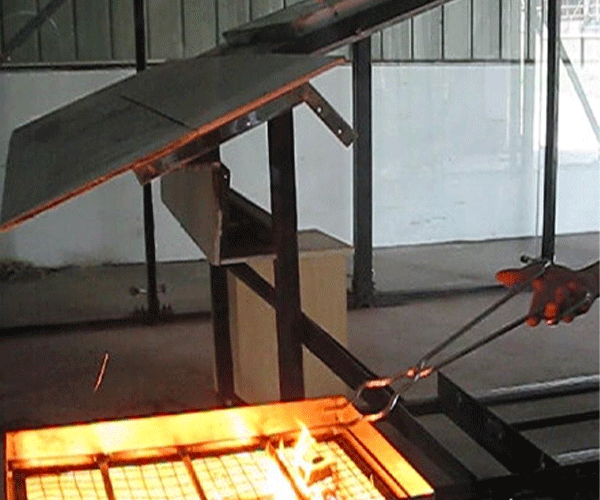
A Fire Resistance Test Furnace is designed to expose building elements to prescribed furnace conditions.
Depending on the application, a fire resistance testing system may include:
Furnace chamber.
Heating and temperature control system.
Temperature measurement sensors.
Specimen supporting frame.
Loading equipment, where required.
Unexposed-side temperature measurement devices.
Integrity assessment arrangements.
Deformation measurement equipment.
Data acquisition and monitoring system.
The furnace provides the required exposure conditions while the measurement system records the performance of the tested element.
6.3 Why Equipment Selection Matters
Selecting the wrong equipment can lead to unsuitable test results or an inability to perform the required test method.
For example, a Single Burning Item Test Apparatus cannot replace a fire resistance furnace because it is not designed to assess the time-based integrity, insulation, or load-bearing performance of a complete building element.
Similarly, a fire resistance furnace does not automatically provide the measurement arrangement needed for EN 13823 SBI Testing.
Laboratories should select equipment according to the required test method and the actual products they intend to evaluate.
7. Which Testing Method Is Suitable for Different Building Products?
The appropriate testing method depends on the product category, intended use, and relevant technical requirements.
7.1 Wall Panels
Wall panels may require different fire performance assessments depending on whether the product is a lining material, a composite panel, or part of a complete fire-separating wall assembly.
For applicable wall lining products, SBI Testing may be relevant for evaluating reaction-to-fire performance.
For a complete wall assembly designed to separate building spaces, Fire Resistance Testing may be required to evaluate integrity and insulation performance. If the wall is load-bearing, the applicable structural requirements may also need to be considered.
7.2 Insulation Materials
Certain insulation products may be subject to reaction-to-fire testing, including SBI Testing where the relevant requirements specify it.
However, an insulation product used within a particular wall or floor assembly may also be part of a larger fire resistance assessment.
The product-level reaction-to-fire result and the fire resistance performance of the complete assembly answer different questions.
7.3 Fire Doors
Fire doors are generally evaluated as assemblies rather than simply as individual materials.
Fire Resistance Testing may assess the door assembly's integrity and insulation performance, as applicable to the relevant standard and classification.
An SBI test of a material used in a door does not establish the fire resistance performance of the complete door assembly.
7.4 Floors and Structural Elements
Flooring products may require specific reaction-to-fire testing methods depending on their category and intended use. SBI Testing should not automatically be assumed to be the appropriate method for every flooring product.
Structural floors and other load-bearing elements may require Fire Resistance Testing to evaluate their performance under specified fire exposure and loading conditions.
7.5 Composite Building Products
Composite products can contain several layers or materials. Their assessment depends on whether the requirement concerns the reaction of the product to fire or the resistance of a complete building element.
Manufacturers should provide detailed product information to the laboratory so that the correct test method can be identified.
8. Can SBI Testing Replace Fire Resistance Testing?
No. SBI Testing cannot replace Fire Resistance Testing because the two methods evaluate different fire performance characteristics.
SBI Testing provides information about a product's reaction to fire, including heat release and smoke production. Fire Resistance Testing evaluates whether a building element maintains specified functions during a defined fire exposure period.
A construction product may have useful reaction-to-fire test data but still need to be assessed as part of a complete building assembly.
Likewise, a building element that has been tested for fire resistance does not automatically have all the reaction-to-fire data required for its constituent products.
In some projects, both types of assessment may be relevant. The required tests depend on product specifications, building regulations, classification requirements, and the intended application.
9. How to Choose the Right Fire Testing Equipment
Before purchasing fire testing equipment, laboratories should identify the exact test methods and products they need to evaluate.
The following considerations can help guide equipment selection.
9.1 Define the Testing Purpose
Determine whether the laboratory needs to evaluate reaction-to-fire performance, fire resistance performance, or both.
This decision will influence the equipment type, specimen dimensions, installation requirements, and measurement configuration.
9.2 Confirm Applicable Standards
Identify the relevant standard and edition for the intended product category.
For SBI Testing, review EN 13823 and applicable classification requirements. For Fire Resistance Testing, identify the relevant general and product-specific standards.
9.3 Review Equipment Configuration
For an SBI Test Apparatus, examine the burner, exhaust collection, gas analysis, smoke measurement, and data acquisition systems.
For a Fire Resistance Test Furnace, review the furnace dimensions, heating system, temperature measurement, supporting frame, loading arrangement, and other required monitoring functions.
9.4 Check Laboratory Conditions
Both types of testing equipment may require significant installation planning.
Consider available space, ventilation, exhaust connections, gas supply, electrical requirements, specimen handling, and operator safety.
9.5 Evaluate Technical Support
Ask suppliers about installation guidance, equipment operation, maintenance instructions, calibration arrangements, training, and troubleshooting support.
A detailed technical proposal should identify the equipment configuration and explain how it supports the intended testing method.
10. Frequently Asked Questions
What is the main difference between SBI Testing and Fire Resistance Testing?
SBI Testing evaluates the reaction-to-fire performance of applicable construction products, including heat release and smoke production. Fire Resistance Testing evaluates the ability of building elements to maintain specified functions, such as load-bearing capacity, integrity, and insulation, during fire exposure.
Is SBI Testing the same as a fire resistance test?
No. SBI Testing is a reaction-to-fire test associated with EN 13823. Fire Resistance Testing evaluates the performance of building elements under prescribed furnace exposure conditions. They are different testing methods.
Which standard is used for SBI Testing?
EN 13823 is the standard associated with the Single Burning Item test for applicable construction products.
Which standards are used for Fire Resistance Testing?
EN 1363-1 provides general fire resistance testing requirements. Product-specific standards include relevant parts of the EN 1364, EN 1365, and EN 1634 series, depending on the element being tested.
Can wall panels require both types of testing?
Yes, depending on the product and its intended application. A wall lining product may require reaction-to-fire assessment, while a complete wall assembly may also need fire resistance evaluation.
What equipment is used for SBI Testing?
A typical SBI Test Apparatus includes a specimen mounting frame, burner, exhaust hood and duct, gas analysis instruments, smoke measurement system, and data acquisition software.
What equipment is used for Fire Resistance Testing?
A Fire Resistance Test Furnace is used to expose the test specimen to prescribed fire conditions. The complete system may include temperature sensors, loading equipment, specimen frames, integrity assessment arrangements, and data monitoring devices.
11. Choose the Correct Testing Method for Your Product
SBI Testing and Fire Resistance Testing are both important parts of construction fire performance assessment, but they serve different purposes.
SBI Testing evaluates how applicable construction products react when exposed to a controlled burner. It provides information about fire growth, heat release, and smoke production through indicators such as FIGRA, THR, SMOGRA, and TSP.
Fire Resistance Testing evaluates how a building element maintains its required functions during specified fire exposure. Depending on the element, this may include load-bearing capacity, integrity, and insulation performance.
The correct testing method depends on the product category, intended use, applicable standards, and assessment requirements. Manufacturers and laboratories should clearly define their testing objectives before selecting equipment or arranging laboratory services.
Choosing the appropriate Single Burning Item Test Apparatus or Fire Resistance Test Furnace helps ensure that the testing system matches the required procedure and provides relevant information for product evaluation.
Understanding the difference between SBI Testing and Fire Resistance Testing is therefore an important step toward selecting suitable fire testing equipment, planning laboratory work, and evaluating construction product fire performance accurately.


Comment
(0)