


When we evaluate rubber materials, we do not look only at how they perform at room temperature. Many rubber products work in environments where heat and mechanical stress are part of everyday operation. Cable insulation may experience elevated temperatures during service, while rubber components used in industrial equipment can be exposed to repeated heating, stretching, and changes in load. Under these conditions, a material that performs well in a normal laboratory environment may behave differently.
At Guangzhou Chuangge Automation Equipment Co., Ltd., we understand why manufacturers and laboratories need practical ways to evaluate material performance under controlled conditions. Our testing equipment business focuses on customized solutions for industrial quality inspection, material research, and product development. A Hot Elongation Tester can help users investigate how a suitable material stretches or changes shape when it is heated and subjected to a specified load.
For customers working with rubber compounds, polymer materials, and cable insulation, hot elongation testing can provide useful information about material stability. The test results may help identify differences between formulations, compare production batches, or check whether a material meets the requirements of a particular technical specification. The value of the test comes from controlling the conditions and recording the results consistently, rather than simply heating a sample and observing what happens.
We also recognize that the term “hot elongation tester” can refer to different testing arrangements. Some applications focus on elongation under load at elevated temperature, while the hot-set test for cross-linked cable insulation and sheathing materials follows a defined procedure that includes measurements before and after the load is removed. The correct equipment configuration therefore depends on the intended material, the applicable standard, and the measurements required.
At the beginning of a project, we encourage customers to explain what they want to test and which standard they need to follow. This helps us review the required heating conditions, specimen holders, loading arrangement, measurement method, and documentation. Our goal is to help customers identify a practical equipment configuration that fits their laboratory work, rather than offering a generic specification that may not match their application.
1. What Is a Hot Elongation Tester?
A Hot Elongation Tester is testing equipment used to evaluate the elongation behavior of suitable materials under elevated-temperature conditions. Depending on the test method, a prepared specimen may be heated while a specified tensile load is applied. The operator then measures the change in length and, where required, observes how much of the deformation remains after the load is removed and the specimen has cooled.
In simple terms, the tester helps answer a practical question: when a material becomes hot and is placed under tension, how much does it stretch, and how well does it recover afterward? These measurements can provide useful evidence about the material's behavior under the particular conditions used in the test.
For rubber and polymer materials, heat can change how molecular chains move and how the material responds to force. Some materials may stretch more easily at elevated temperatures. Others may retain more of their shape after the load is removed. The actual response depends on the polymer type, formulation, curing or cross-linking process, specimen geometry, temperature, and applied stress.
A hot elongation test is not the same as a standard tensile test performed at room temperature. A conventional tensile test often measures properties such as tensile strength and elongation at break. A hot elongation test focuses on behavior under specified elevated-temperature conditions and may include a recovery measurement after unloading. These tests can complement one another, but they answer different questions.
Why do manufacturers need hot elongation testing?
Material selection is easier when manufacturers have more than appearance or general product descriptions to rely on. Two rubber compounds may look similar but respond differently when exposed to heat and a sustained load. By testing representative specimens under controlled conditions, a laboratory can compare the materials using recorded measurements rather than assumptions.
For example, a cable manufacturer may need to assess the behavior of cross-linked insulating or sheathing materials under a defined hot-set procedure. A rubber compound developer may want to understand how a formulation responds to temperature and stress. In both cases, the test provides information that can support material evaluation, process review, and quality control.
However, one test result should not be treated as a complete description of a material's service life. A hot elongation test does not automatically predict long-term aging, fatigue resistance, chemical resistance, or performance under every real-world condition. If those properties matter to the intended application, additional tests may be necessary.
Hot elongation testing and hot-set testing
Customers in the wire and cable industry often use the term “hot elongation tester” when referring to equipment for hot-set testing of cross-linked insulation and sheathing compounds. IEC 60811-507:2012 specifies a hot-set test method for cross-linked materials used in electric and optical fibre cables. The method includes heating a specimen under a specified load and evaluating elongation, followed by a recovery stage after the tensile force is removed.
Not every rubber elongation test follows that exact procedure. ASTM D1456, for example, addresses elongation of soft vulcanized rubber compounds under a specified stress. Its scope and test conditions differ from the cable hot-set procedure. We therefore recommend confirming the required standard before deciding whether a particular tester is suitable.
| Testing approach | Main purpose | Important point |
|---|---|---|
| Hot elongation testing | Evaluate material extension under specified elevated-temperature conditions | Temperature, load, specimen dimensions, and measurement procedure must be defined |
| Hot-set testing for cross-linked cable materials | Measure elongation under load and assess recovery according to the prescribed procedure | Follow the applicable cable specification and IEC 60811-507 where required |
| Room-temperature tensile testing | Determine tensile properties such as tensile strength and elongation at break | Does not replace an elevated-temperature test when hot performance is the concern |
Reference sources: IEC 60811-507:2012 — Hot set test for cross-linked materials; ASTM D1456-86(2026) — Elongation at Specific Stress; ISO 37:2024 — Tensile stress-strain properties of rubber.
These methods should not be treated as interchangeable. When we review a project, we first establish whether the customer needs a cable hot-set test, another elevated-temperature elongation procedure, or a separate tensile property test. That distinction affects the equipment arrangement and the way the results are interpreted.
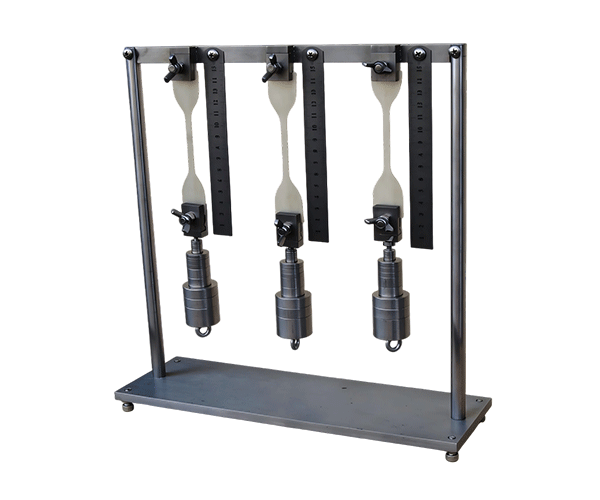
2. How Does a Hot Elongation Tester Work?
The general principle is straightforward: prepare a specimen, expose it to a defined temperature, apply the required load where the method calls for it, and measure the resulting change in length. The exact sequence depends on the applicable standard. For that reason, operators should follow the specified procedure rather than use one set of conditions for every rubber or polymer sample.
Step 1: Prepare the specimen
Testing begins with a specimen that meets the requirements of the selected method. The sample may be prepared from a molded rubber sheet, a cable insulation or sheathing compound, or another suitable material form. Its shape, thickness, length, and surface condition can affect the measurement, so specimen preparation should follow the applicable procedure.
Before testing, the laboratory should identify the material and record relevant details such as its grade, formulation code, production batch, and specimen dimensions. If two compounds are being compared, using consistent specimen preparation helps make the results more meaningful. A poorly prepared sample may introduce variation that has little to do with the actual difference between the materials.
Step 2: Measure the initial gauge length
Many elongation tests use marked reference points on the specimen. The distance between these marks is known as the gauge length. After the specimen is exposed to the test conditions, the distance can be measured again to determine the change in length.
For a hot-set procedure, the position of the marks and the required measuring method are defined by the applicable standard. The operator should use the prescribed gauge length and measurement technique rather than choosing a convenient distance. Consistent marking is particularly important when small differences in elongation need to be compared.
Step 3: Set the required temperature
The specimen is placed in a heating chamber or oven suitable for the selected test method. The temperature must reach and remain within the specified range for the required part of the procedure. A stable temperature helps reduce variation caused by changes in the heating environment.
The required temperature is not the same for every material. It depends on the applicable product specification, material category, and test method. We therefore do not recommend choosing a tester based only on a broad temperature claim. Customers should confirm the required operating range, temperature tolerance, chamber capacity, and any special measurement requirements before placing an order.
Step 4: Apply the specified load
Where the test method requires loading, the specimen is secured in the appropriate grips and the specified tensile force is applied. In many hot-set arrangements, a weight is attached to the lower end of a vertically suspended specimen. The load causes the specimen to stretch while it is held at the required temperature.
The load must match the selected method. Applying too much or too little force can change the measured elongation, so the load arrangement should be checked carefully. Customers should also confirm how the weights or loading accessories are supplied and whether the equipment needs to accommodate more than one specimen at a time.
Step 5: Measure elongation under the test conditions
After the specimen has been exposed to the specified conditions for the required period, its gauge length is measured according to the procedure. The change in length is used to calculate elongation. In simplified form, elongation is expressed as the increase in length divided by the original gauge length, multiplied by 100 percent.
For example, if an original gauge length of 20 mm increases to 30 mm, the increase is 10 mm and the calculated elongation is 50%. This is only an arithmetic example, not a recommended test condition or acceptance limit. Actual specimen dimensions, heating conditions, loading periods, and calculations must follow the applicable standard.
Step 6: Remove the load and evaluate recovery when required
Some hot-set procedures include a recovery stage. After the specified period under load, the tensile force is removed and the specimen is allowed to recover under the required conditions. After cooling, the distance between the gauge marks is measured again.
This stage helps the operator understand how much deformation remains after the load is removed. A specimen may stretch under heat and tension but recover much of its original length afterward. Another specimen may retain more permanent deformation. The meaning of the result depends on the material and the acceptance criteria defined by the applicable specification.
Step 7: Record and review the results
The laboratory records the measurements and other information required by the selected method. Depending on the procedure, the record may include the material identification, specimen dimensions, temperature, applied load, test duration, elongation under load, recovery result, and observations during testing.
Keeping complete records helps when a manufacturer compares different batches, investigates an unexpected result, or prepares documentation for a customer. If the laboratory needs automatic data acquisition or customized report templates, those requirements should be discussed before the equipment configuration is finalized.
Our approach is to clarify the measurement process first and then review the equipment needed to carry it out. That way, the heating system, specimen grips, loading accessories, and measurement arrangement can be considered as parts of one testing workflow.
3. Key Features and Technical Considerations When Selecting a Hot Elongation Tester
A useful Hot Elongation Tester needs to do more than heat a sample. It must support the specified test procedure and allow operators to prepare, load, measure, and record specimens in a consistent way. Because our company focuses on customized testing equipment, we encourage customers to start with the test requirements rather than assume that every model includes the same functions.
Temperature control and stability
Temperature is one of the key conditions in elevated-temperature testing. If the temperature changes significantly during a test, the material may respond differently, making comparisons more difficult. The heating chamber should therefore be suitable for the required test temperature and its specified tolerance.
When reviewing a proposed configuration, customers should check the operating temperature range, temperature uniformity requirements, control method, and any required temperature verification. These are separate considerations: a controller may display a set temperature, but the laboratory may also need to verify actual temperature conditions according to its own quality procedures.
Specimen grips and loading arrangements
The grips need to hold the specimen securely without creating avoidable damage at the clamping points. The loading system must also be suitable for the prescribed force and specimen arrangement. For a vertical hot-set test, the way the specimen is suspended and the load is attached can influence how practical the test is to perform.
We recommend confirming the specimen form and expected dimensions before selecting the grips. Cable insulation compounds, molded rubber specimens, and other polymer samples may have different preparation requirements. The equipment should be configured for the actual specimen type rather than relying on a general description such as “rubber testing.”
Measurement and observation
The test method determines how elongation and recovery are measured. Some laboratories use manual measurements with suitable measuring tools, while others may require a more specialized arrangement. The correct choice depends on the procedure, the expected measurement range, and the laboratory's workflow.
If your team needs digital measurement, automated recording, or software-assisted calculations, please include those requirements in the inquiry. Such functions should be evaluated against the standard and the intended measurement process. We do not assume that automated measurement or reporting is included unless it is specified in the agreed equipment scope.
Multi-specimen capacity
Some laboratories test several specimens in a batch to compare materials or verify production consistency. In these cases, the number of specimens that can be accommodated at once may affect productivity. However, increasing the specimen capacity also requires consideration of chamber space, loading arrangements, temperature uniformity, and operator access.
When estimating the required capacity, think about the number of specimens tested each day, the number of material types, and the time needed for specimen preparation and cooling. A configuration that suits a small research laboratory may not be ideal for a production quality-control department that handles many batches.
Safety and operator convenience
Elevated-temperature testing involves hot surfaces, heated specimens, and loading accessories that may remain hot after the test. Appropriate handling procedures, protective equipment, and a suitable installation environment are important. The laboratory should assess the risks associated with the specific material and test method and establish safe operating procedures.
We recommend discussing the laboratory's available space, electrical supply, ventilation needs, and operator workflow during the specification stage. These details help clarify installation requirements and reduce the chance of discovering practical issues after delivery.
Common configuration items
| Item | What to confirm | Why it matters |
|---|---|---|
| Test method | Applicable standard, edition, and procedure | Defines the required conditions and measurement steps |
| Temperature system | Required temperature range, tolerance, and verification needs | Supports controlled heating during the test |
| Loading system | Required load values, weights, and specimen arrangement | Ensures the test uses the prescribed tensile force |
| Specimen grips | Sample shape, dimensions, and clamping requirements | Helps hold specimens securely and consistently |
| Measurement method | Gauge length, measurement tools, and recording requirements | Supports consistent elongation and recovery calculations |
| Capacity | Number of specimens per test cycle | Helps match equipment to laboratory workload |
| Documentation | Operating instructions, technical documents, and acceptance records | Supports routine operation and internal quality procedures |
This table is a selection checklist, not a list of standard features included with every tester. The actual equipment configuration, accessories, and technical parameters must be confirmed in the final quotation and specification.
4. Standards, Test Results, and Practical Interpretation
In material testing, the standard is not just a reference number printed on a report. It defines how the specimen should be prepared, how the test should be conducted, which conditions must be controlled, and how the results should be recorded. If a laboratory uses the wrong method, even carefully measured data may not answer the question it intended to investigate.
For hot elongation and related testing, the appropriate standard depends on the material and application. IEC 60811-507:2012 covers the hot-set test for cross-linked materials used in electric and optical fibre cables. ASTM D1456 covers elongation of soft vulcanized rubber compounds under specified stress. ISO 37:2024 addresses tensile stress-strain properties of vulcanized and thermoplastic rubbers, including elongation at specified stress in the methods it describes.
These standards address related material properties but are not substitutes for one another. A cable manufacturer working to a product specification may need to follow a particular hot-set procedure, while a rubber compound developer may need a different elongation test. We recommend checking the full standard and the relevant product specification before confirming the equipment requirements.
How to understand elongation and recovery
Elongation describes how much a specimen increases in length compared with its original gauge length. It is usually expressed as a percentage. Recovery describes the change that occurs after the load is removed and the specimen is allowed to recover under the conditions specified by the test method.
In a simplified example, imagine that a specimen has an initial gauge length of 20 mm. Under the test conditions, the gauge length becomes 28 mm. The increase is 8 mm, which corresponds to 40% elongation. If the specimen is unloaded and cooled, its final gauge length may be shorter than 28 mm but still longer than the original 20 mm. The difference provides information about residual deformation.
This example explains the calculation only. It does not establish whether 40% elongation or any particular recovery value is acceptable. Acceptance limits depend on the material specification and test method. A laboratory should never use an illustrative value as a universal pass-or-fail criterion.
Why repeatability matters
When comparing materials or production batches, consistency in specimen preparation and test conditions is essential. Differences in specimen thickness, gauge length, conditioning, temperature, load, or timing can influence the result. If these factors are not controlled, it may be difficult to determine whether a change comes from the material itself or from the testing process.
We recommend keeping a clear record of the conditions used for each test and checking that the equipment remains suitable for the intended procedure. Laboratories may also have internal requirements for verification, calibration, maintenance, and measurement traceability. Those requirements should be established by the laboratory's quality system and applicable regulations.
Hot elongation compared with related material tests
| Test | What it evaluates | Typical reason to use it |
|---|---|---|
| Hot elongation or hot-set testing | Elongation under specified elevated-temperature conditions and, where required, recovery after unloading | Assess thermal deformation behavior for a defined application |
| Tensile stress-strain testing | Properties such as tensile strength, elongation at break, and stress at specified elongation | Compare basic mechanical properties of rubber materials |
| Heat aging | Changes in material properties after exposure to specified heat-aging conditions | Investigate changes after thermal exposure over a defined period |
| Compression set | Residual deformation after compression under specified conditions | Assess the ability of a material to recover after compression |
Reference sources: IEC 60811-507:2012; ISO 37:2024; ASTM International — Rubber Standards. The table summarizes the general purposes of these test types. The full standards define the detailed procedures and applicable requirements.
For a purchasing team, the practical lesson is simple: choose the tester based on the property you need to evaluate, not just the name of the equipment. If you need to measure hot-set elongation in cross-linked cable insulation, make that requirement explicit. If you need general rubber tensile testing or thermal aging, the appropriate equipment may be different.
5. Applications in Rubber, Cable, Polymer, and Quality Control Industries
Hot elongation testing can be useful wherever the behavior of a rubber or polymer material under heat and load needs to be assessed. The value of the test depends on choosing the correct method for the material and intended use. At Guangzhou Chuangge Automation Equipment Co., Ltd., we support customers across several industrial sectors with testing equipment customization and technical requirement review.
Wire and cable manufacturing
Wire and cable products often use polymeric insulation and sheathing materials. Depending on the cable design and applicable specification, these materials may need to meet requirements related to mechanical behavior, thermal exposure, and cross-linking performance.
For suitable cross-linked cable materials, a hot-set test can help evaluate elongation under load and recovery after unloading. These results can form part of a broader quality-control process used to compare material batches or verify that a production process remains within the specified requirements.
Before choosing equipment for cable testing, we recommend identifying the cable standard, material type, required test temperature, load, duration, specimen preparation method, and acceptance criteria. These details are more useful for equipment selection than simply stating that the laboratory tests “cable rubber.”
Rubber product manufacturing
Rubber manufacturers work with different formulations, curing systems, fillers, and processing conditions. Changes in these factors can influence how a material responds to heat and tension. Hot elongation testing may help compare suitable compounds and investigate unexpected differences between batches.
For example, if two formulations produce similar-looking finished components but show different elongation under a specified hot test, the laboratory can use that information as part of its material review. The result does not identify the cause by itself, but it can help the technical team decide whether additional investigation is needed.
Plastic and polymer material development
Polymer research teams often need to compare material behavior under different conditions. Elevated-temperature deformation testing may be relevant when studying candidate materials, evaluating formulation changes, or checking whether a material is suitable for a particular use.
Not every plastic or elastomer should be tested using the same hot elongation method. Thermoplastic materials, thermosetting materials, cross-linked compounds, and elastomers can respond differently to heating and loading. The laboratory should confirm that the chosen method is appropriate for the material under investigation.
Electrical components and household appliances
Electrical components and appliances may include rubber seals, flexible parts, insulating materials, cable assemblies, and polymer components. Where elevated-temperature mechanical behavior is relevant, suitable material tests can support development and quality inspection.
The test result should be considered alongside other product requirements. For example, a rubber seal may also need to meet compression-set, aging, chemical-resistance, or dimensional requirements. A hot elongation result alone cannot establish whether the complete component will perform correctly throughout its intended service life.
Research laboratories and third-party inspection
Research laboratories may use hot elongation testing to compare formulations, investigate the effects of processing conditions, or collect data for material studies. Third-party testing laboratories may need a defined procedure and a documented equipment configuration to support customer testing and reporting.
In both cases, the laboratory should confirm the required measurement range, test method, documentation, and verification arrangements. If accreditation or formal traceability is important to the project, those requirements need to be reviewed separately from the basic equipment specification.
Application summary
| Industry | Possible testing objective | Information to provide |
|---|---|---|
| Wire and cable | Evaluate hot-set behavior of suitable cross-linked insulation or sheathing materials | Cable standard, compound type, temperature, load, and specimen requirements |
| Rubber manufacturing | Compare material elongation and deformation under specified conditions | Rubber type, specimen dimensions, loading conditions, and test method |
| Polymer research | Study how material composition affects deformation at elevated temperature | Material form, intended measurements, and research procedure |
| Electrical components | Support evaluation of selected rubber or polymer parts | Component material, applicable product requirements, and other relevant tests |
| Quality inspection laboratories | Perform repeatable tests and maintain records | Standard edition, measurement requirements, verification, and reporting needs |
This application overview is intended to help customers identify possible uses. It does not mean that one equipment configuration automatically covers every material type or test method listed. We review each application against the actual technical requirements before confirming the proposed configuration.
6. Customization, Manufacturing, Inspection, and Delivery
At Guangzhou Chuangge Automation Equipment Co., Ltd., we understand that laboratories do not all work in the same way. Some customers need a configuration for routine production inspection, while others require equipment for research, specialized materials, or a defined test procedure. Our customization process begins by understanding these differences and translating them into a clear equipment specification.
Requirement review
We begin by reviewing the intended test method, material type, specimen dimensions, temperature requirements, applied load, test duration, and measurement process. If the customer is working to a particular international or national standard, we ask for the exact reference and edition whenever possible.
It is also helpful to know how many specimens the laboratory expects to test, whether the test needs to be repeated frequently, and what information must appear in the test record. If special fixtures, additional measurement functions, or customized documentation are needed, these requirements should be identified before the final specification is approved.
Equipment configuration and technical confirmation
After reviewing the application, the proposed configuration can be documented for customer confirmation. This stage should clarify the heating arrangement, loading system, specimen holders, measurement approach, included accessories, utilities, and documentation. Any optional function should be listed clearly rather than assumed to be included.
We recommend that customers check the technical specification carefully before confirming the order. If the equipment must meet a particular laboratory acceptance procedure, the expected checks should be defined in advance. This helps both parties understand what will be demonstrated before shipment and which documents will be supplied.
Manufacturing and assembly
Once the technical requirements are agreed, production and assembly can proceed according to the confirmed scope. The details of the manufacturing process depend on the final design and the components required. Because customized testing equipment may include different combinations of heating, mechanical loading, control, and measurement functions, the production plan should follow the approved configuration.
Our company has a portfolio of more than 20 patents, including invention patents, utility model patents, and software patents. This reflects our involvement in equipment-related technical development, but it should not be taken to mean that every feature of every product is covered by a particular patent. Any product-specific intellectual property claim should be checked against the relevant patent scope.
Functional inspection and performance verification
Before delivery, the equipment undergoes functional inspection and performance verification according to the agreed scope. The purpose is to check the operation of the supplied functions and confirm that the agreed equipment behavior can be demonstrated.
For a hot elongation tester, the specific inspection items depend on the final configuration. The customer should confirm in advance whether the acceptance process needs to cover temperature control, loading arrangements, timing functions, specimen holders, measurement accessories, or other features. These items should not be assumed to have been tested unless they are included in the agreed inspection scope.
Functional inspection and performance verification are not automatically the same as formal calibration or third-party certification. If your laboratory requires accredited calibration, traceability documentation, or an independent conformity assessment, please discuss these requirements before ordering so that their availability and scope can be clarified.
Technical documents and operating instructions
Operating instructions and technical documentation are provided as agreed with the customer. These documents support equipment setup, routine operation, and basic maintenance. Operators must still be trained to follow the applicable test standard and the laboratory's own safety and quality procedures.
For laboratories working under a formal quality management system, we recommend keeping equipment identification information, maintenance records, test records, and relevant verification or calibration documents. The required records depend on the laboratory's own procedures and the standards it follows.
Production lead time, payment, and shipping
Our typical production cycle for customized testing equipment is approximately 30 to 60 days, depending on equipment specifications and customization requirements. This is a general planning range, not a guaranteed delivery date for every order. The confirmed schedule depends on the final technical scope, order arrangements, and production requirements.
Payment terms can be negotiated based on order requirements. We recommend confirming the payment schedule, production lead time, equipment scope, acceptance requirements, and shipping arrangements in the purchase documentation before production begins.
We can arrange sea, air, or land transportation according to the destination and delivery needs. Protective packaging and sturdy wooden cases are used where appropriate to help protect equipment and accessories during transport. The exact packaging arrangement depends on the equipment dimensions, weight, destination, and selected shipping method.
Our goal is to make the purchasing process clear from the initial technical discussion through final delivery. When requirements and acceptance criteria are documented in advance, both the supplier and the customer have a more reliable basis for planning the order and preparing the equipment for laboratory use.
7. Why Choose Guangzhou Chuangge Automation Equipment Co., Ltd.?
Choosing a Hot Elongation Tester is not just about comparing prices or selecting the machine with the longest feature list. The more important question is whether the equipment suits the intended test method, can be integrated into the laboratory's workflow, and comes with a clear scope of supply.
We focus on customized testing equipment
Guangzhou Chuangge Automation Equipment Co., Ltd. specializes in the customization of testing equipment for industrial applications. Our product and project experience covers areas including construction materials and components, wires and cables, plastics and textiles, electrical plugs, sockets and switches, electronic products, and household appliances.
For hot elongation testing, we use the customer's stated test requirements as the starting point. We encourage customers to identify the material, test method, temperature, load, specimen dimensions, and measurement requirements before finalizing the equipment configuration. This approach helps prevent misunderstandings about what the tester is designed to do.
We take standards and technical requirements seriously
A product description alone cannot replace a test standard. Our approach is to clarify which procedure the customer needs to perform and then review the relevant equipment functions. When the customer provides the exact standard or a laboratory test procedure, it becomes easier to identify the required conditions and the items that need to be confirmed.
We also distinguish between general equipment functions, standard-specific requirements, and optional services such as formal calibration or third-party assessment. Keeping these categories separate helps customers understand the scope of supply and make a more informed purchasing decision.
We maintain certified management systems
Our company has obtained ISO 9001 quality management system certification, ISO 14001 environmental management system certification, and ISO 45001 occupational health and safety management system certification. These certifications relate to management systems within their respective certified scopes. They are not product-specific certificates and do not, by themselves, establish that an individual Hot Elongation Tester meets every technical requirement of a particular standard.
Our corporate philosophy is to ensure survival through high technology and drive development through high quality. In practical terms, we aim to support clear technical communication, defined specifications, agreed inspection arrangements, and appropriate documentation for customized equipment projects.
We consider the customer's working environment
A laboratory may have limited space, a particular specimen preparation process, or specific requirements for data records. A production quality-control department may prioritize repeatable routine testing, while a research laboratory may need more flexibility for different material types. These differences can affect the most suitable configuration.
By discussing the application before production, we can review whether the proposed arrangement fits the customer's workflow and identify any additional requirements that need to be addressed. We prefer to clarify these points early rather than leave the customer to discover them after delivery.
We aim for clear delivery expectations
Our typical production cycle is 30 to 60 days, subject to the agreed equipment specifications and customization requirements. We discuss payment terms, shipment options, protective packaging, and technical documentation as part of order coordination. The final details should be confirmed in the quotation and purchase documents.
We believe a reliable equipment project depends on clear expectations on both sides. By confirming the test method, technical scope, acceptance requirements, and delivery arrangements before production, customers can make a better-informed decision about whether the proposed Hot Elongation Tester is suitable for their work.
8. Frequently Asked Questions About the Hot Elongation Tester
Q1: What materials can a Hot Elongation Tester evaluate?
The suitable material range depends on the equipment configuration and test method. Applications may include selected rubber compounds, polymer materials, and cross-linked cable insulation or sheathing compounds. Not every material uses the same procedure, so we recommend providing the material type and specimen details before equipment selection.
Q2: Is a Hot Elongation Tester the same as a hot-set tester?
The terms are sometimes used in related applications, especially in the wire and cable industry, but they should not automatically be treated as identical. IEC 60811-507 specifies a hot-set test for cross-linked cable materials. Other hot elongation tests may use different specimen requirements, loading conditions, or measurement procedures. Confirm the exact standard before choosing the equipment.
Q3: Which standard should I follow for cable insulation?
For cross-linked materials used in electric and optical fibre cable insulation or sheathing, IEC 60811-507:2012 is an important reference for the hot-set test. The applicable cable product specification may define the required test conditions and acceptance criteria. Always check the current requirements that apply to your specific cable and market.
Q4: Can the tester be used for general rubber elongation testing?
That depends on the required method and the tester's configuration. General rubber tensile and elongation testing may require different equipment from a hot-set test for cable compounds. Please provide the relevant standard and required measurements so that the equipment requirements can be reviewed accurately.
Q5: What information do I need before requesting a quotation?
We recommend providing the test standard and edition, material type, specimen dimensions, required temperature, applied load, test duration, measurement method, number of specimens per test cycle, and any special documentation or data-recording needs. If some details are not yet available, send the information you have so we can identify which points need further confirmation.
Q6: Can the equipment be customized?
Customization can be discussed according to the intended application. Potential areas for review include specimen holders, loading arrangements, temperature requirements, measurement accessories, specimen capacity, and documentation needs. The availability of each option depends on the test method and must be confirmed in the final technical specification.
Q7: How long is the production cycle?
The typical production cycle for our customized testing equipment is approximately 30 to 60 days. The actual lead time depends on the final specifications, degree of customization, and order requirements. We recommend confirming the schedule after the technical scope has been agreed.
Q8: Does the tester automatically calculate elongation?
Automatic calculation or electronic data-recording functions should be confirmed as part of the equipment specification. Depending on the test method and configuration, measurements may require operator input or additional measurement accessories. If your laboratory needs automatic calculation, data export, or customized report formats, please state these requirements before ordering.
Q9: What inspection is carried out before delivery?
The equipment undergoes functional inspection and performance verification according to the agreed scope. The specific checks depend on the configuration and acceptance requirements. Formal calibration, accredited measurement services, or third-party certification are separate matters unless explicitly included in the order.
Q10: How is the equipment shipped?
We can arrange sea, air, or land transportation based on the destination and delivery requirements. Protective packaging and sturdy wooden cases are used where appropriate. The final shipping method, packaging details, and related costs should be confirmed during order coordination.
Q11: Does a passing hot elongation result guarantee long-term product durability?
No. A hot elongation or hot-set result describes material behavior under the specified test conditions. Long-term durability can also depend on thermal aging, fatigue, chemicals, moisture, mechanical loading, and the actual service environment. Other tests may be needed to evaluate these factors.
Q12: Does ISO certification of the supplier mean the tester itself is certified?
No. ISO 9001, ISO 14001, and ISO 45001 are management system certifications within their respective scopes. They should not be presented as product-specific certification. If your project requires a product certificate, formal calibration, or independent conformity assessment, please identify that requirement separately so its scope can be reviewed.
Request a Customized Hot Elongation Tester
If you are looking for a Hot Elongation Tester for rubber material evaluation, cable hot-set testing, polymer research, or production quality control, we invite you to contact Guangzhou Chuangge Automation Equipment Co., Ltd. with your application details.
To help us review your requirements, please provide the applicable standard, material type, specimen dimensions, required temperature, applied load, test duration, measurement method, and any additional functions or documentation you need. If the equipment will be used for cross-linked cable insulation or sheathing materials, please specify whether the required procedure follows IEC 60811-507 or another applicable cable standard.
We can discuss the equipment configuration, customization requirements, typical production cycle, functional inspection, technical documentation, payment terms, packaging, and shipping arrangements according to your project. Our typical production cycle is 30 to 60 days, depending on the final specifications and customization requirements.
At Guangzhou Chuangge Automation Equipment Co., Ltd., we believe the right testing equipment starts with a clear understanding of the material and the test method. By confirming the requirements before production, we can establish a more practical basis for equipment selection and help customers prepare for consistent laboratory testing.
Contact our team to discuss your Hot Elongation Tester requirements and request a configuration based on your material testing application.
Technical References
IEC 60811-507:2012 — Electric and optical fibre cables: Hot set test for cross-linked materials
ASTM D1456-86(2026) — Standard Test Method for Rubber Property: Elongation at Specific Stress
ISO 37:2024 — Rubber, vulcanized or thermoplastic: Determination of tensile stress-strain properties
Note: This page provides general product and application information. The applicable standard, test conditions, equipment functions, technical specifications, and acceptance requirements must be confirmed against the customer's application and the final agreed technical documentation.
