


1. Introduction: A Practical Way to Check Appliance Door Durability
At Guangzhou Chuangge Automation Equipment Co., Ltd., we understand that an appliance door is more than a simple cover. It is a moving part that people use every day, sometimes dozens of times. Whether it belongs to a refrigerator, washing machine, oven, dishwasher, or another household appliance, the door must open smoothly, close properly, and remain reliable after repeated use. A hinge that becomes loose, a latch that stops working, or a door that no longer aligns with the body can affect both the user experience and the overall quality of the product.
That is why we provide customized testing equipment, including the Appliance Door Durability Tester For Repeated Opening And Closing Cycle Testing. This equipment is designed to simulate repeated door operation under defined test conditions. Instead of asking workers to open and close a door manually thousands of times, manufacturers can use a controlled testing system to repeat the same movement and record relevant results.
Our approach is straightforward: understand the appliance, confirm the test requirements, design a suitable fixture and operating mechanism, and verify the equipment before delivery. We do not assume that every appliance door has the same dimensions, weight, opening angle, hinge arrangement, or closing force. These differences matter when building a reliable durability test system.
For example, a refrigerator door may be relatively heavy and fitted with magnetic seals. A washing machine door may use a locking mechanism and a different hinge arrangement. An oven door may have to accommodate a handle, a specific opening angle, and a structure designed for its operating environment. A single standard fixture may not be suitable for all these products.
Our Appliance Door Durability Tester can be developed around the customer's sample, target cycle count, operating method, and required measurement functions. Depending on the project, the equipment may support automatic opening and closing, adjustable operating parameters, cycle counting, status monitoring, and emergency stopping. The final configuration is confirmed during technical discussions rather than assumed in advance.
We focus on making the test repeatable and practical for production quality teams, product development engineers, inspection laboratories, and appliance manufacturers. The goal is to help customers identify mechanical weaknesses before products reach the market, improve product development decisions, and build a clearer picture of how doors behave after repeated operation.
As a manufacturer specializing in customized testing equipment, we also understand that the tester itself must be suitable for daily use. Fixture stability, movement consistency, electrical control, operator access, and maintenance requirements all influence the usefulness of the final system. We consider these factors during design and assembly so that the equipment can support the customer's actual testing workflow.
2. How the Appliance Door Durability Tester Works
2.1 Simulating Repeated Opening and Closing
The basic working principle is easy to understand. The tester holds the appliance or its door assembly in a suitable fixture, then uses a mechanical or electrically controlled drive system to move the door through a defined operating sequence. The door opens to a specified position and returns to the closed position according to the agreed test settings. This sequence repeats until the target number of cycles is reached or the test is stopped.
A cycle must be defined clearly before testing begins. Depending on the customer's test procedure, one cycle may mean one complete opening and closing sequence. The exact definition should be recorded in the test plan, particularly when results will be compared between different samples, production batches, or laboratories.
We work with customers to determine how the movement should be produced. Some applications require a simple repeated movement. Others need a controlled opening angle, a specific movement speed, a defined pause, or a particular closing action. Where the original door uses a latch, lock, damper, spring, or other mechanical feature, the test method should take that feature into account.
2.2 Setting the Test Parameters
Before we build a customized appliance door cycle tester, we review the parameters that have the greatest effect on the test. These commonly include door dimensions, door mass, hinge location, opening angle, movement speed, cycle count, dwell time, and the way the door is opened and closed. If the test requires force measurement or other monitoring, we discuss the sensor arrangement and data requirements as well.
These parameters should reflect the intended test method. A door that opens too quickly may experience different mechanical loading from one that follows its normal operating movement. Likewise, a fixture that applies force at the wrong point can produce misleading results. Our engineering team therefore pays attention to the relationship between the drive mechanism, the contact point, the hinge position, and the sample's normal operating direction.
We also consider whether the door is tested as part of a complete appliance or as a separate assembly. Testing the complete product may be necessary when the surrounding cabinet, frame, sealing surface, or locking system affects performance. In other cases, a door and hinge assembly may be sufficient. This decision affects fixture design, equipment size, and the way the sample is secured.
2.3 Monitoring the Test and Inspecting the Sample
Cycle counting is an important function because it allows the operator to track progress and identify when the target count has been reached. Depending on the selected configuration, the tester may also support operating-status indicators, parameter adjustment, fault alerts, or automatic stopping when a predefined condition is met.
Not every project needs the same monitoring functions. A basic endurance test may only require controlled movement and reliable counting. A research project may require additional sensors, force measurement, position feedback, or data collection. We confirm these requirements before finalizing the equipment design.
After a test, the sample should be inspected against the agreed acceptance criteria. Engineers may check for hinge looseness, deformation, abnormal noise, cracking, latch problems, changes in alignment, or reduced closing performance. If the test includes measured force or displacement, those readings can be compared with the initial measurements or the limits defined in the test plan.
It is important to separate the tester's functions from the final product assessment. The equipment creates and controls the test movement; the test procedure defines what is measured and how the result is judged. A cycle count alone does not automatically prove that an appliance door meets every durability or safety requirement.
2.4 Typical Test Sequence
| Stage | Operation | Purpose |
|---|---|---|
| 1. Sample preparation | Check the door assembly, hinge arrangement, and mounting points. | Confirm that the sample is suitable for the planned test. |
| 2. Fixture installation | Secure the appliance or door assembly in the test position. | Reduce unwanted movement and maintain consistent alignment. |
| 3. Parameter setup | Set the agreed movement, cycle count, and operating sequence. | Match the customer's test procedure. |
| 4. Trial operation | Run a short trial and check the movement path. | Identify fixture interference or incorrect positioning before endurance testing. |
| 5. Repeated cycling | Run the programmed opening and closing sequence. | Apply repeated mechanical operation under controlled conditions. |
| 6. Final inspection | Inspect the sample and compare results with the test criteria. | Record any damage, abnormal movement, or performance changes. |
This sequence is a general workflow rather than a universal test specification. The actual process, cycle count, inspection points, and acceptance limits should be confirmed according to the product, customer's internal procedure, and applicable requirements.
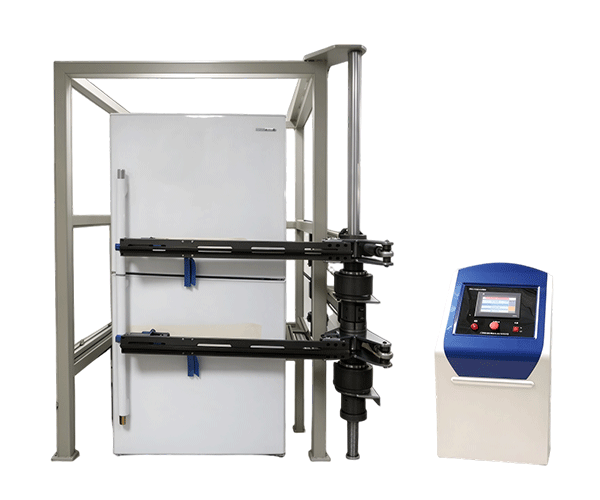
3. Main Features and Customization Options
3.1 A Fixture Designed for the Actual Appliance
In our experience, fixture design is one of the most important parts of an appliance Door Durability Testing machine. If the sample is poorly supported, the test may introduce movement that does not occur during normal use. If the fixture blocks the door or puts pressure on the wrong area, the results may not represent the intended operating conditions.
We therefore begin by collecting drawings, photographs, sample dimensions, hinge positions, door weight, and information about the intended mounting method. When drawings are unavailable, sample inspection and a technical discussion can help establish the necessary design details.
The fixture may be adjustable to accommodate different samples, or it may be developed for one specific appliance model. An adjustable fixture can be useful for laboratories that test multiple products. A dedicated fixture may be more suitable for production lines where the same model is tested repeatedly. We evaluate both approaches with the customer.
3.2 Controlled Opening and Closing Movement
The drive mechanism must provide the movement required by the test. Depending on the application, a system may use an electric actuator, motor-driven mechanism, pneumatic actuator, or another suitable arrangement. The selection depends on the required force, travel, speed, control method, available utilities, and the characteristics of the door.
We do not treat one drive method as suitable for every project. For example, a heavy door may require a different drive and support arrangement from a small access panel. A door that needs a carefully controlled movement profile may require a different control strategy from one that only needs a repeated basic cycle.
During design, we consider the door's natural hinge axis and the point where the operating force is applied. We also review whether the drive mechanism can complete the full movement without excessive side loading, interference, or sudden impact. The objective is to create a repeatable test action that matches the agreed procedure.
3.3 Cycle Counting and Control
A repeated opening and closing test can run for many hours or longer, depending on the target count and cycle speed. A reliable counter helps the operator see how much testing has been completed and when the programmed target has been reached.
The control system can be configured according to the project's complexity. Typical options may include a control panel, adjustable cycle settings, start and stop functions, status indicators, and an emergency stop. More advanced projects may call for position sensors, force sensors, data recording, or additional monitoring functions.
We confirm the control requirements before production. For example, if the customer needs to export test data, the data format and communication method should be discussed at the beginning. If the customer only needs a final cycle count and a manual inspection record, a simpler system may be sufficient.
3.4 Safety and Operator Access
Repeated movement creates mechanical hazards around hinges, linkages, and contact points. We consider operator access and moving-part protection during equipment design. Depending on the risk assessment and application, suitable measures may include protective covers, guarding, emergency-stop devices, electrical protection, and controlled access to moving components.
The appropriate safety arrangement depends on the final machine configuration, operating environment, and applicable local requirements. A protective cover, for example, must not interfere with the test movement or prevent necessary sample inspection. We discuss these details as part of the technical design instead of adding them as an afterthought.
We also consider routine operation. Operators should be able to install the sample, check the fixture, set the required parameters, start the test, and remove the sample without unnecessary difficulty. Clear controls and practical access can reduce setup mistakes and make repeated testing easier to manage.
3.5 Typical Configuration Options
| Item | Possible Configuration | Information to Confirm |
|---|---|---|
| Sample fixture | Dedicated fixture or adjustable mounting structure | Sample dimensions, mass, hinge position, and mounting points |
| Drive mechanism | Electric, pneumatic, or other suitable drive | Required force, movement range, speed, and available utilities |
| Motion control | Defined opening and closing sequence | Opening angle, operating speed, pauses, and closing method |
| Cycle counter | Preset target count and cycle display | Cycle definition, target count, and counting logic |
| Monitoring | Status indication, sensors, or data collection | Required measurements, data format, and reporting needs |
| Safety features | Emergency stop and suitable protective measures | Risk assessment, operator access, and applicable requirements |
The options in this table describe possible engineering arrangements, not a claim that every item is included in every standard machine. We confirm the final configuration in the technical proposal and order documents so that both sides understand what will be supplied.
4. Technical Advantages and Test Planning
4.1 Repeatability Instead of Manual Guesswork
Manual testing can be useful for quick checks, but it becomes difficult to maintain consistent movement over a large number of cycles. Different operators may apply different forces, open the door to different angles, or close it at different speeds. Fatigue can also affect the result during a long test.
An automatic appliance door endurance tester helps reduce these variations by repeating a defined movement. Once the setup has been checked and the operating parameters have been confirmed, the system can perform repeated cycles without relying on an operator to produce every movement manually.
Automation does not remove the need for good test planning. If the fixture is incorrectly installed or the wrong parameters are selected, a machine can repeat the wrong action just as consistently. We therefore recommend checking the sample installation, performing a trial run, and recording the agreed settings before starting a long test.
4.2 Better Visibility Into Mechanical Wear
Door mechanisms contain several parts that can change during repeated use. Hinges may loosen, fasteners may move, latches may wear, and sealing surfaces may become misaligned. A durability test provides a controlled way to apply repeated movement so that engineers can inspect these parts at planned intervals or after the target count has been reached.
When a project requires interim inspections, the test plan should specify when the machine will stop and what will be checked. For example, the customer may request inspections at defined cycle milestones rather than waiting until the final cycle. This can help engineers understand when a change first appears.
Where relevant sensors are included, the equipment may also help monitor selected variables such as operating force or movement position. However, those measurements depend on the actual sensor configuration and calibration requirements. We confirm the measurement range, accuracy requirements, and data handling method before including them in a customized system.
4.3 Supporting Product Development and Quality Control
Durability testing can support more than final inspection. During product development, engineers can compare different hinge designs, latch structures, materials, or door assemblies. If two designs are tested under the same defined conditions, the results can provide useful evidence for engineering decisions.
For production quality teams, repeated-cycle testing can be used as part of a broader quality control plan. The sampling frequency and acceptance criteria should be based on the customer's quality system, product risk, and testing requirements. A durability tester is not a replacement for every other inspection, but it can provide useful information about mechanical performance over time.
For laboratories, a well-defined test procedure helps maintain consistency between samples and test sessions. The procedure should document the sample identification, initial condition, test parameters, cycle definition, inspection method, and result. If equipment settings are changed between tests, those changes should be recorded so that results remain understandable.
4.4 Standards and Reference Documents
We encourage customers to identify the standard, internal specification, or customer test method that applies to the appliance door before equipment design begins. Not every door durability test uses the same cycle count, movement speed, opening angle, or pass/fail criteria. The correct test method depends on the product type and the purpose of the evaluation.
IEC 60335-1 addresses general safety requirements for household and similar electrical appliances. It may be relevant to a wider appliance safety evaluation, but its existence should not be taken as proof that every door endurance test is governed by the same procedure. The applicable product-specific requirements and clauses must be reviewed for the particular appliance.
For this reason, we ask customers to provide the relevant standard number and edition, specific clauses where available, or their internal test procedure. Our engineering team can then review the equipment requirements with the customer. Where a requirement is unclear, it should be confirmed before the machine is manufactured rather than interpreted through guesswork.
Official reference: IEC 60335-1 – Household and Similar Electrical Appliances: Safety, Part 1: General Requirements.
4.5 Example of a Test Planning Sheet
| Planning Item | Example Entry | Why It Matters |
|---|---|---|
| Sample identification | Appliance model and door assembly reference | Links the test result to the correct product. |
| Cycle definition | One complete opening and closing sequence | Prevents different interpretations of the cycle count. |
| Movement settings | Opening angle, speed, and closing method as agreed | Defines how the door will be operated. |
| Target cycles | Value specified by the customer or test method | Sets the planned duration and endpoint of the test. |
| Inspection points | Hinge, latch, alignment, noise, and visible damage | Defines what will be checked during or after testing. |
| Acceptance criteria | Customer-defined limits and pass/fail rules | Provides a consistent basis for evaluating results. |
The entries above are examples of planning fields, not universal test values. We do not assign a mandatory cycle count or acceptance limit without knowing the product and the applicable procedure. This is particularly important when a customer needs results for formal verification, supplier approval, or a product certification process.
5. Applications Across Household Appliance Manufacturing
5.1 Refrigerator and Freezer Doors
Refrigerator and freezer doors are opened and closed frequently throughout normal use. Depending on the design, the door may include hinges, handles, magnetic seals, dampers, door-closing mechanisms, and other components. Repeated operation can reveal changes in hinge stability, alignment, closing behavior, and the condition of the sealing area.
Our refrigerator door durability testing solution can be configured around the door dimensions, opening direction, mounting structure, and operating method. For a full-size appliance, the fixture may need to support the cabinet securely while leaving enough space for the door to move through its required range. For a smaller assembly, a more compact fixture may be appropriate.
Customers should also consider whether the test is intended to assess the complete refrigerator door or a specific hinge or closing mechanism. Testing a complete appliance may reveal interactions between the door and cabinet that are not present in a component-only test.
5.2 Washing Machine and Dryer Doors
Washing machine and dryer doors can use different hinge arrangements, latches, and locking mechanisms. Their size and opening direction also vary by product design. In some cases, the test must consider how the door interacts with the frame or locking system.
When developing a washing machine door cycle tester, we review the required opening angle, movement sequence, sample support, and the intended condition of the locking mechanism during the test. If the test needs to reproduce a specific operating sequence, that sequence should be documented before the control system is configured.
It is also useful to determine whether the customer wants to test a door assembly by itself or a door installed on the complete appliance. The answer influences the fixture structure, available working space, and the method used to apply the opening and closing movement.
5.3 Ovens, Dishwashers, and Other Appliances
Oven and dishwasher doors can differ considerably in weight, hinge design, handle position, and opening resistance. Some designs use spring-assisted hinges or other mechanisms that affect the force needed to open and close the door. A test system must accommodate these features without introducing unintended loading.
For these products, we review the movement path and the intended contact point before selecting the drive mechanism. If the door has a defined stop position or a special closing action, the fixture and control sequence should be designed around that requirement.
Other possible applications include access doors, equipment covers, control-panel doors, and similar hinged assemblies. The suitability of the machine depends on the sample and required movement. We evaluate each application individually rather than assuming that one configuration can cover every type of door.
5.4 Product Development Laboratories and Quality Inspection Teams
Research and development teams may use an appliance door durability tester when comparing prototypes or checking the effect of a design change. For example, engineers may want to compare two hinge structures or investigate whether a change in door mass affects the operating mechanism.
Quality inspection teams may use the equipment to evaluate samples from production batches or to investigate a reported door problem. In these cases, the test plan should make clear whether the purpose is routine sampling, comparative analysis, failure investigation, or verification against a specified requirement.
Testing laboratories may have additional needs, such as repeatable fixtures, documented setup procedures, measurement records, and access to the test sample for inspection. We can discuss these needs during project planning and determine which functions should be integrated into the equipment.
6. How We Manufacture and Verify Customized Testing Equipment
6.1 Requirement Review and Engineering Design
At Guangzhou Chuangge Automation Equipment Co., Ltd., we start a customized testing equipment project by understanding the customer's application. We ask what product will be tested, what the test must demonstrate, which standard or internal procedure applies, and how the equipment will be used in daily work.
For an appliance door durability tester, useful information includes product drawings, sample photographs, door weight, hinge location, opening direction, required angle, cycle count, operating speed, and the desired control functions. We also ask about available installation space, power supply, compressed air if required, operator access, and any reporting needs.
After reviewing these details, we develop a proposed equipment arrangement. This may include the frame, sample fixture, drive mechanism, control system, protective measures, and optional measurement functions. We clarify the scope with the customer before moving into production. This helps avoid misunderstandings about what the equipment is expected to do.
6.2 Mechanical Fabrication and Assembly
Mechanical fabrication focuses on building a structure that can support the sample and withstand repeated operation. The frame and fixture must be suitable for the expected loads and movement. Alignment is important because an incorrect fixture position can affect the movement path or place unnecessary stress on the door.
During assembly, the drive mechanism, mounting parts, moving components, and control devices are installed according to the approved design. The team checks that the parts fit together and that the mechanism can complete the intended movement without obvious interference.
Where a project requires a special fixture, the fixture is developed around the agreed sample geometry. If the customer expects to test several models, we discuss whether interchangeable mounting parts or an adjustable structure would be useful. The right approach depends on how often the product changes and how much setup time the customer can accept.
6.3 Electrical Integration and Control Setup
The electrical control system connects the operating mechanism with the functions needed by the test. Depending on the agreed specification, it may manage start and stop commands, cycle counting, parameter settings, status indication, and safety-related controls. Additional sensors or data collection functions can be included when required.
We review the control logic against the intended test sequence. For example, the equipment should follow the agreed opening and closing pattern, count cycles consistently, and stop in the manner specified by the control design. If the customer requires a particular response to a fault or interruption, this should be defined and verified during commissioning.
Operator instructions are also important. Clear guidance helps users understand how to install the sample, check the fixture, select the settings, start the test, and respond to a stop or fault condition. The final documentation is provided according to the agreed project scope.
6.4 Inspection and Performance Verification Before Delivery
Before delivery, we carry out functional inspection and performance verification based on the equipment specification and agreed acceptance requirements. The exact verification items depend on the design. They may include checking the operating mechanism, cycle counter, control functions, movement range, fixture installation, and the operation of specified safety features.
Where suitable, a trial run is used to confirm that the door mechanism follows the intended sequence. If the customer has supplied a sample or representative fixture information, we can use the agreed setup to check the equipment's basic operation. Any formal acceptance test should follow the criteria confirmed with the customer before production.
We do not treat an ordinary functional check as proof of every possible test capability. For example, a force measurement function requires suitable sensors and an agreed measurement method. A requirement for a specific measurement accuracy also needs to be included in the technical specification and verified accordingly.
6.5 Project Timeline and Delivery Arrangements
For our customized testing equipment projects, the typical production cycle is around 30 to 60 days, depending on the equipment specifications and customization requirements. A relatively straightforward configuration may follow a different schedule from a project requiring a special fixture, complex control functions, additional sensors, or extensive engineering review.
We confirm the expected schedule after the technical scope has been reviewed. If the customer needs a sample trial, special components, or additional acceptance checks, these requirements should be discussed early because they can affect the project timeline.
Before shipment, the equipment is prepared with suitable protective materials and packed in sturdy wooden cases or other agreed packaging. We can discuss sea, air, or land transportation according to the destination, delivery schedule, equipment size, and customer requirements. Payment terms are negotiable and should be confirmed in the commercial agreement.
Our company operates with ISO 9001, ISO 14001, and ISO 45001 management system certifications, as provided in our company information. We also hold a portfolio of more than 20 patents covering invention patents, utility model patents, and software patents. These are part of our broader commitment to developing customized testing equipment and supporting practical industrial applications.
7. Why Choose Guangzhou Chuangge Automation Equipment Co., Ltd.?
7.1 We Start With the Test Requirement, Not a Fixed Machine
One of the main difficulties in buying a customized durability tester is that product names alone do not explain the full testing requirement. Two customers may both ask for an appliance door cycle tester but have very different samples, cycle counts, operating methods, and data needs.
We therefore begin with the test itself. Our team reviews the customer's application and helps identify the information needed to define the equipment. This gives both sides a clearer basis for discussing the design, schedule, price, and acceptance conditions.
We also encourage customers to distinguish essential functions from optional features. If a project only needs repeated movement and cycle counting, there may be no reason to add complex data systems. If the project requires measured force, position feedback, or detailed records, those functions should be included in the initial design rather than added later without planning.
7.2 Experience Across Different Testing Applications
Our testing equipment business covers applications involving construction materials and components, wires and cables, plastics and textiles, electrical plugs, sockets and switches, electronic products, and household appliances. These fields have different sample characteristics and test requirements, so we understand the importance of adapting equipment to the job.
For appliance door durability testing, this means considering the mechanical movement, the sample fixture, the control method, and the inspection procedure together. The equipment must not only complete repeated cycles; it must also make sense within the customer's testing workflow.
Our engineering approach is based on reviewing the application and confirming the details before production. We do not assume that a machine suitable for one product can automatically be used for another without checking the relevant differences.
7.3 Clear Technical Communication
Good communication is especially important for customized equipment because many important details are settled before the machine is built. We work with customers to confirm the sample, movement path, test sequence, cycle definition, monitoring requirements, and acceptance criteria.
We recommend that customers share the latest drawings and test procedures whenever possible. If there is a particular clause in a standard that the machine must support, providing the reference makes it easier to discuss the necessary functions. If the requirement is not fully defined, we can help identify the questions that need to be resolved before the technical proposal is finalized.
We also aim to make the final equipment scope clear. The agreed documentation should state which functions are included, which parameters are adjustable, what accessories will be supplied, and which verification items will be checked before shipment. This reduces the risk of different expectations during acceptance.
7.4 Quality Management and Intellectual Property
Our company has obtained ISO 9001, ISO 14001, and ISO 45001 certifications, covering quality management, environmental management, and occupational health and safety management. These systems support the way we manage our business and manufacturing activities, while the actual functions and acceptance requirements of each tester remain defined by its project specification.
We also have more than 20 patents, including invention patents, utility model patents, and software patents. Our development work focuses on customized testing equipment and practical solutions for industrial customers. When discussing a specific project, we explain the equipment configuration and functions relevant to that application rather than relying on general claims.
7.5 Support From Project Planning to Delivery
Our work does not end with selecting a machine name. We discuss the test requirement, prepare the proposed configuration, manufacture and assemble the equipment, verify its agreed functions, and arrange the documentation and packing. This process gives customers a clearer view of how the project will progress.
We can also discuss practical matters such as the expected production period, payment arrangements, shipping method, and packaging requirements. The usual production cycle is approximately 30 to 60 days, with the final schedule depending on the complexity of the customized equipment. Payment terms and delivery details are confirmed through the commercial agreement.
If you are looking for an Appliance Door Durability Tester For Repeated Opening And Closing Cycle Testing, we welcome you to share your sample details, drawings, target cycle count, and test requirements. With this information, we can discuss a suitable configuration and provide a proposal based on your actual application.
8. Frequently Asked Questions About Appliance Door Durability Testers
Q1. What is an Appliance Door Durability Tester used for?
An Appliance Door Durability Tester is used to repeat the opening and closing movement of an appliance door under defined conditions. It helps manufacturers and laboratories evaluate mechanical durability and inspect for problems such as hinge looseness, deformation, latch wear, alignment changes, or abnormal movement after repeated use. The exact evaluation depends on the test procedure and acceptance criteria.
Q2. Which products can be tested with this equipment?
Potential applications include refrigerator doors, freezer doors, washing machine doors, dryer doors, oven doors, dishwasher doors, access covers, and other hinged assemblies. Suitability depends on the sample size, mass, hinge arrangement, opening direction, movement range, and required operating method. We review these details before confirming the equipment design.
Q3. Can the machine be customized for different door sizes?
Yes. We can discuss a dedicated fixture for one product or an adjustable fixture for several models. The best option depends on the range of sample dimensions, how frequently models change, and the setup time the customer can accept. We generally need drawings, photographs, or sample measurements to evaluate the fixture design.
Q4. What is the maximum cycle count?
The required cycle count should be specified by the customer or the applicable test procedure. The equipment configuration must then be reviewed to ensure it is suitable for the intended test duration and operating conditions. We do not publish one universal maximum cycle count for every customized configuration because drive design, loading, speed, and control requirements can differ between projects.
Q5. Can the opening angle and movement speed be adjusted?
These functions can be considered during customization. The available adjustment range depends on the drive mechanism, fixture design, and control system. If the test requires specific angles, speeds, dwell times, or closing behavior, please provide those values or the relevant test procedure so we can confirm the suitable configuration.
Q6. Does the tester automatically determine whether a door passes or fails?
Not necessarily. The basic equipment can repeat the movement and count cycles, while the pass/fail decision depends on the agreed test criteria. Automatic evaluation may be possible when the required sensors, measurement functions, and decision logic are included in the design. Visual inspection or manual measurements may still be required for certain defects.
Q7. Can the equipment measure opening or closing force?
Force measurement can be discussed as an optional function. The project must define the measurement point, expected force range, required accuracy, sensor arrangement, calibration method, and how the data will be recorded. If force measurement is important to your test, please include it in the initial inquiry so we can assess the technical requirements.
Q8. Which standards does the tester comply with?
The applicable requirements depend on the appliance and the intended test. IEC 60335-1 covers general safety requirements for household and similar electrical appliances, but it should not be treated as a universal door durability test procedure. Customers should identify the relevant product-specific standard, clause, internal specification, or customer test method. We can then review the equipment requirements against the information provided.
Q9. How long does manufacturing take?
Our typical production cycle for customized testing equipment is approximately 30 to 60 days. The actual lead time depends on the mechanical structure, fixture complexity, control functions, special components, and verification requirements. We confirm the expected schedule after the technical scope has been reviewed.
Q10. What inspections are carried out before shipment?
Each unit undergoes functional inspection and performance verification according to the agreed equipment specification. Depending on the project, checks may cover movement, cycle counting, control functions, fixture installation, and specified safety features. If the customer requires a particular acceptance test or report, that requirement should be agreed before production.
Q11. Can you provide operating instructions and technical documents?
Yes. Operating instructions and technical documentation can be supplied as agreed for the project. The required documents should be confirmed before delivery, particularly when the customer needs specific electrical information, operating procedures, maintenance guidance, or acceptance records.
Q12. How is the equipment packed and shipped?
We use protective materials and sturdy wooden cases or other agreed packaging to help protect the equipment during transportation. Shipping can be arranged by sea, air, or land according to the destination, equipment size, schedule, and customer requirements. The packaging and delivery arrangement are confirmed before shipment.
Q13. What information should I provide to request a quotation?
To help us prepare a practical proposal, please provide the appliance type, sample dimensions, door weight, hinge location, opening angle, required cycle count, movement speed, test procedure, and any required measurement or data functions. Drawings and photographs are especially helpful. Please also tell us the destination country, expected delivery schedule, and any special documentation requirements.
Q14. Are payment terms fixed?
Payment terms are negotiable and should be confirmed in the commercial agreement. The final quotation can also clarify the expected production period, packaging method, transportation option, and the scope of technical documentation supplied with the equipment.
Request a Customized Appliance Door Durability Tester
Reliable door durability testing begins with a clear understanding of the product and the test method. A suitable tester should repeat the required movement, hold the sample securely, provide the necessary cycle control, and support the inspections or measurements defined by the customer.
At Guangzhou Chuangge Automation Equipment Co., Ltd., we develop customized testing equipment around practical application requirements. We review the sample, confirm the operating sequence, discuss the fixture and control functions, and verify the agreed equipment performance before delivery. Our goal is to help customers build a repeatable testing process that supports product development and quality control.
If you need an Appliance Door Durability Tester For Repeated Opening And Closing Cycle Testing, please contact our team with your product drawings, sample information, target cycle count, applicable standard, and preferred functions. We will review your requirements and discuss a suitable customized solution, production schedule, and delivery arrangement.
Reference Sources
International Electrotechnical Commission (IEC), IEC 60335-1: Household and Similar Electrical Appliances – Safety, Part 1: General Requirements. This reference describes general appliance safety requirements; the applicable product-specific requirements should be checked separately.
International Organization for Standardization (ISO), Quality Management. This resource explains the role of quality management systems in controlling processes and supporting continual improvement.
