Guangzhou Chuangge Automation Equipment Co., Ltd. provided customized Fire Resistance Testing equipment for the Guangdong Institute of Product Quality Supervision and Inspection. The project features horizontal and vertical furnace configurations designed for Fire Resistance Testing of Small Building Components. With adjustable dimensions and customizable temperature rise curves, the equipment can be configured to meet different testing requirements and laboratory applications.
1. Project Background and Testing Requirements
Fire resistance testing is an important part of evaluating the performance of building components under high-temperature conditions. Different materials, component structures, and testing standards may require different furnace configurations and heating procedures. Therefore, laboratories need testing equipment that can accommodate specific specimen sizes, temperature profiles, and test arrangements.
For this project, Chuangge developed horizontal and vertical furnace solutions to support fire resistance testing of small building components. The equipment is intended for professional testing environments where controlled heating conditions and suitable furnace dimensions are essential to the testing process.
2. Customized Horizontal and Vertical Furnace Design
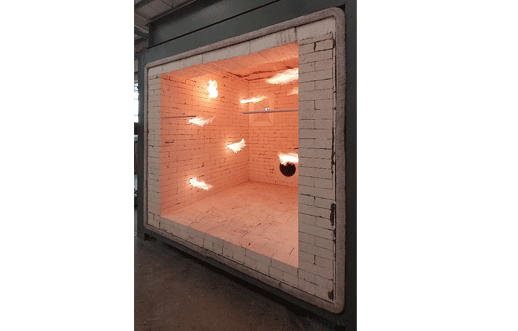
As shown in the project images, the equipment features a robust external structure, a refractory-lined internal chamber, heating components, gas supply and control arrangements, and dedicated electrical control cabinets or panels.
The Horizontal Furnace provides a chamber arrangement suitable for specimens that require horizontal installation. The vertical furnace offers an alternative configuration for tests involving vertically positioned specimens. These two arrangements allow the equipment configuration to be selected according to specimen geometry, laboratory space, and the intended testing method.
The furnace dimensions can be customized to suit individual project requirements. The refractory lining forms the internal heating chamber, while the external structure supports the furnace assembly and associated components. Access platforms or stairs are also shown on the larger furnace installation, providing practical access for equipment operation and maintenance where required.
3. Customizable Temperature Rise Curves
One of the key features highlighted in the project images is the ability to customize temperature rise curves. The displayed graph compares several heating profiles, illustrating how different fire testing procedures may follow different temperature-time relationships.
The listed profiles include:
Tunnel fire RABT-ZTV temperature rise curve
Hydrocarbon fire (HC) temperature rise curve
Petroleum and petrochemical industry temperature rise curve
Electric power fire test temperature rise curve
GB 9978 standard temperature rise curve
Outdoor fire temperature rise curve
Slow temperature rise fire curve
These profiles represent different testing scenarios and heating requirements. The appropriate curve depends on the applicable standard, test objective, and specimen requirements. Actual curve programming, control accuracy, temperature measurement locations, and allowable deviations should be confirmed against the agreed technical specifications for each project.
4. Furnace Structure and Operational Configuration
The equipment shown in the images incorporates an insulated furnace chamber, a supporting steel structure, heating arrangements, and control components. The chamber lining is designed to provide the thermal environment required for the specified test procedure, while the external structure houses and supports the main assemblies.
The control system is an important part of the overall configuration. Depending on the agreed design, it can be arranged to manage the heating process and monitor temperature changes during testing. The final control functions, sensor configuration, data recording capability, and safety interlocks should be specified according to the customer’s operational and testing requirements.
Because different laboratories may handle different specimen sizes and test procedures, the horizontal and vertical furnace dimensions can be adjusted during project design. This customization helps customers plan equipment installation around their available space and testing workflow.
5. Applications and Testing Considerations
Customized Fire Resistance Furnaces may be used in laboratories, product quality inspection organizations, research institutions, and facilities evaluating the fire performance of building materials and components.
When selecting this type of equipment, users should consider the following factors:
Specimen dimensions, orientation, and loading conditions
Applicable fire resistance testing standards
Required temperature rise curve and heating duration
Temperature measurement and recording requirements
Furnace chamber dimensions and installation space
Gas supply, exhaust arrangements, and operational safety
Equipment inspection, acceptance criteria, and documentation
It is important to distinguish between equipment customization and formal test certification. The furnace can be configured for a particular test method, but compliance with a standard must be assessed using the applicable requirements, verified equipment performance, and the laboratory’s testing procedures.
6. Chuangge’s Customized Testing Equipment Capabilities
Guangzhou Chuangge Automation Equipment Co., Ltd. specializes in customized testing equipment for multiple industrial sectors, including construction materials and components, wires and cables, plastics and textiles, electrical plugs, sockets and switches, electronic products, and home appliances.
The company emphasizes technology development, product quality, and an understanding of relevant testing standards. It holds ISO 9001 quality management, ISO 14001 environmental management, and ISO 45001 occupational health and safety management system certifications. Its intellectual property portfolio includes more than 20 patents covering invention patents, utility model patents, and software patents.
Through projects such as the customized horizontal and vertical fire resistance testing furnaces, Chuangge demonstrates its ability to develop equipment around specific application requirements. By considering furnace structure, adjustable dimensions, heating profiles, and control arrangements during project planning, the company helps customers identify testing equipment configurations suited to their intended laboratory work.


Comment
(0)